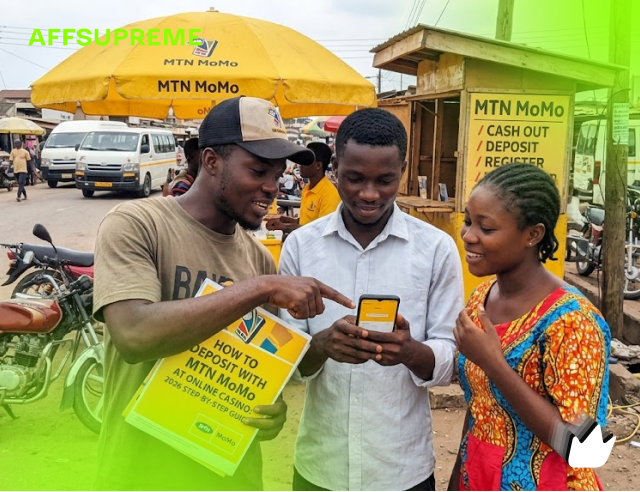
How to Deposit with MTN MoMo at an Online Casino (2026): Ghana & Uganda Guide
Want to know how to deposit with MTN MoMo at an online casino? MTN Mobile Money is the most common way to fund a casino account in Ghana and Uganda. A deposit usually takes under a minute: you choose MTN MoMo in the cashier, approve a prompt with your PIN, and your balance updates. But a few details decide whether it goes smoothly, from your wallet’s limits to which number you register and which merchant code you pay.
This guide covers Ghana and Uganda, the two MTN markets where online casinos are licensed separately and where we checked the regulators’ lists in October 2026. You’ll find step-by-step instructions for each country, MoMo limits, fees and taxes, brand-by-brand quick guides, fixes for failed deposits and the scams to avoid.
Advertising disclosure: AffSupreme may earn a commission when you sign up through links on this page. This never changes our advice, and we only recommend operators licensed in the country concerned. Gambling is for adults and involves financial risk.
📌 Key takeaways
- Most casinos take MTN MoMo through a payment prompt: choose MTN in the cashier, enter the amount, and approve with your MoMo PIN.
- MTN’s USSD codes are *170# in Ghana and *165# in Uganda; use them to check your balance or, in Uganda, to pay a merchant code the casino gives you.
- Minimum deposits are tiny: GHS 1 at betPawa, SportyBet and Betika in Ghana, and UGX 1,000 at 22Bet in Uganda.
- Your MoMo tier sets your daily limit: GHS 3,000 a day on minimum KYC in Ghana, and UGX 3,000,000 on MTN Uganda’s low-value tier.
- Ghana: no tax on winnings since April 2025, and the 1% E-Levy on MoMo transfers was scrapped the same month.
- Uganda: players must be 25+, a 15% withholding tax applies to net winnings, and all betting payments run through a licensed gateway.
⚡ Quick guide: deposit with MTN MoMo in 6 steps
- Log in to a licensed casino on its official site or app.
- Open Deposit and choose MTN Mobile Money.
- Enter the amount and your MTN number (the one registered on your account).
- Approve the prompt on your phone with your MoMo PIN.
- Wait for the SMS from MTN and the casino; most deposits arrive within seconds.
- Keep the transaction ID until your balance updates.
📲 MTN MoMo casino basics by country
| Detail | 🇬🇭 Ghana | 🇺🇬 Uganda |
|---|---|---|
| USSD code | *170# | *165# |
| Usual deposit method | Payment prompt from the casino cashier | Payment prompt, or Pay Bill/merchant code on *165# |
| Regulator | Gaming Commission of Ghana (GCG) | National Lotteries and Gaming Regulatory Board (NLGRB) |
| Casino licence | “Online Casino” entry on the GCG register | “CS” licence number on the NLGRB list |
| Legal age | 18 | 25 |
| Tax on winnings | None since 2 April 2025 | 15% of net winnings since 1 July 2026 |
| Other MoMo-related charges | 1% E-Levy abolished on 2 April 2025 | 0.5% excise when you cash out at an agent |
| Main alternatives | Telecel Cash, AirtelTigo Money | Airtel Money |
⚖️ Is it legal to use MTN MoMo at online casinos?
MTN MoMo is just the payment method. What matters is whether the casino is licensed in your country.
- 🇬🇭 Ghana: the Gaming Act 2006 (Act 721) makes running an unlicensed gaming business a criminal offence, and the GCG licenses online casinos separately. Every licence on its 2026 register runs from 1 January to 31 December 2026. In 2025, the authorities blocked the payment platforms of ten illegal operators and restricted access to 11 websites, according to iGaming Times. Ghana Card details are the standard ID for verification.
- 🇺🇬 Uganda: the NLGRB’s 2026 list includes separate online casino (“CS”) licences. Anyone under 25 counts as a minor for gambling. Since 1 July 2025, Section 93A of the Tax Procedures Code requires betting payments to go through a Bank of Uganda-licensed gateway linked to the Uganda Revenue Authority, 22Bet’s guide explains, and the regulator told Parliament in August 2026 that it had blocked 57 illegal sites.
🇬🇭 How to deposit with MTN MoMo in Ghana
Ghanaian casinos almost all use the payment prompt. You don’t need to dial a code to deposit; the casino sends the request to your phone.
Step by step
- Log in on the casino’s official .com.gh site or app, using the number you registered with.
- Tap Deposit and select MTN Mobile Money.
- Enter the amount, at or above the minimum (GHS 1 at betPawa, SportyBet and Betika).
- Approve the prompt that appears on your phone with your 4-digit MoMo PIN.
- Check the SMS confirmations from MTN and the casino. betPawa says deposits usually reflect within seconds, and in under a minute in most cases.
Deposit from the same number you registered with. AfricaSoccer’s SportyBet guide notes that withdrawals return to the linked wallet, so using one number avoids delays later.
Checking a deposit on *170#
If your balance hasn’t updated, dial *170# to confirm whether the money left your wallet, and note the transaction reference. AfricaSoccer’s betPawa guide suggests waiting five minutes, checking *170#, and contacting support if the deposit still hasn’t appeared after 10 minutes, with your registered number, the amount, the time and the reference.
📏 MTN MoMo limits in Ghana
Your MoMo account tier decides how much you can deposit. These limits took effect on 1 March 2024, as reported by Graphic Online:
| Tier | Daily transaction limit | Maximum balance | Monthly limit |
|---|---|---|---|
| Minimum KYC | GHS 3,000 | GHS 5,000 | GHS 10,000 |
| Medium KYC | GHS 15,000 | GHS 40,000 | No limit |
| Enhanced KYC | GHS 25,000 | GHS 75,000 | No limit |
Casinos have their own limits too: betPawa caps MoMo deposits at GHS 25,000 per transaction, subject to network limits, and Betika lists GHS 5,000 a day. Check your current tier in the MoMo app before a large deposit.
🧾 Fees and taxes in Ghana
- Casino fees: betPawa, SportyBet and 1xBet say they don’t charge for MoMo deposits, and Betika lists no fee. MTN may still apply its own charge, which appears before you approve.
- E-Levy: the 1% electronic transfer levy was abolished from 2 April 2025, and MTN confirmed it no longer applies to MoMo transfers.
- Winnings tax: the 10% withholding tax on betting winnings was repealed with effect from 2 April 2025, so licensed casinos shouldn’t deduct tax from your winnings.
- VAT on digital services: the Ghana Revenue Authority launched a real-time VAT system on 15 October 2026 for digital services from foreign suppliers, at an effective 20%. Focus Gaming News reports that its guidance doesn’t yet say whether stakes on foreign betting platforms are covered. Locally licensed casinos are the safer bet while that’s unclear.
🏷️ MTN MoMo at Ghanaian casinos: quick guides
All six brands below appear on the 2026 GCG register with Online Casino entries, valid to 31 December 2026.
betPawa Ghana
Tap Deposit, select MTN Mobile Money, enter the amount and confirm with your 4-digit PIN. betPawa doesn’t take cards, bank transfers or Telecel Cash, so MoMo is the main route in. It’s built for small stakes, with a GHS 1 minimum.
Visit betPawa 18+ | T&Cs apply | Gamble responsibly
SportyBet Ghana
Log in, tap Deposit, choose MTN and approve the prompt. SportyBet charges no deposit fee. Sources disagree on whether it currently runs a welcome bonus in Ghana, so check the promotions page rather than depositing for an offer.
Visit SportyBet 18+ | T&Cs apply | Gamble responsiblyBetika Ghana
Betika, run in Ghana by Shade Gold Coast Ltd, also offers a USSD service on *263#, according to BetrankGH, which helps on basic phones. Its casino includes Aviator, with free-bet promotions on the game.
Visit Betika 18+ | T&Cs apply | Gamble responsibly
Betway Ghana
Betway accepts one of the widest mixes of methods in Ghana, including G-Money and cards, and pays out to bank accounts as well as wallets. Choose MTN Mobile Money in the cashier and approve the prompt.
Visit Betway 18+ | T&Cs apply | Gamble responsibly
1xBet Ghana
On 1xbet.com.gh, tap the green Deposit button, choose MTN Mobile Money, enter the amount and confirm the prompt. BetrankGH notes that you should activate the welcome bonus before depositing if you want it, because it’s triggered by your first deposit.
Visit 1xBet 18+ | T&Cs apply | Gamble responsiblyMSport Ghana
MSport, a Chelsea and Borussia Dortmund partner, takes mobile money from GHS 1 and runs its own instant games, Super Kick and Sky Ace, alongside the casino.
Visit MSport 18+ | T&Cs apply | Gamble responsibly🇺🇬 How to deposit with MTN MoMo in Uganda
Ugandan casinos offer two routes: a payment prompt sent from the cashier, which is the easiest, and a USSD payment on *165# using a merchant code the casino gives you.
Method 1: the cashier prompt
- Log in and go to My Account, then Deposit.
- Select MTN Mobile Money from the payment list.
- Enter your MTN number and the amount (from UGX 1,000 at 22Bet).
- Approve the prompt with your MoMo PIN.
- Wait for the SMS. 22Bet says deposits usually arrive within seconds, or a couple of minutes at peak times.
Method 2: USSD on *165#
- Dial *165#.
- Choose Pay Bill, Payment or Goods & Services, depending on your menu.
- Enter the merchant code or ID exactly as the casino’s deposit screen shows it, and a reference if asked.
- Enter the amount and check the details.
- Confirm with your PIN.
Only use a merchant code that the casino’s own deposit screen shows you. 22Bet warns players never to pay a “22Bet” merchant code through MTN MoMo Pay unless its deposit screen displays it, because fake codes circulate. betPawa, for example, uses the merchant code BETPAWA, according to ChampsBase.
📏 MTN MoMo limits in Uganda
MTN Uganda’s Key Facts Document for individual MoMo accounts lists these limits:
| Tier | Maximum single transaction | Maximum daily balance | Maximum daily transfer |
|---|---|---|---|
| Low value | UGX 1,000,000 | UGX 3,000,000 | UGX 3,000,000 |
| Medium value | Shown with a typo on MTN’s page | UGX 10,000,000 | UGX 10,000,000 |
| High value | UGX 5,000,000 | UGX 20,000,000 | UGX 20,000,000 |
Casino limits sit on top: 22Bet shows the maximum on its deposit screen when you choose MTN, and ChampsBase found Betika Uganda’s limits at UGX 5,000,000 per request and UGX 10,000,000 a day. Your MoMo limit can cap a deposit below the casino’s maximum.
🧾 Fees, taxes and gateway rules in Uganda
- Casino fees: 22Bet charges 0% on deposits. MTN’s tariff applies and is shown on the confirmation screen before you enter your PIN.
- Small-deposit fee: ChampsBase found an MTN fee of UGX 110 on betPawa deposits under UGX 2,000, so a UGX 1,000 deposit costs proportionally more than a larger one.
- Winnings tax: a 15% withholding tax on net winnings has applied since 1 July 2026. LiveScore’s example: a UGX 10,000 stake returning UGX 50,000 carries UGX 6,000 in tax, deducted by the operator.
- Cash-out duty: a 0.5% excise applies when you withdraw cash from your MoMo wallet, not when the casino pays you. Cashing out UGX 500,000 costs UGX 2,500 in duty.
- Gateway rule: every deposit passes from your wallet through a Bank of Uganda-licensed gateway that records it for the Uganda Revenue Authority, then to your casino balance. If the wallet, gateway and casino show different statuses, 22Bet explains, the deposit stays pending until the records match.
🏷️ MTN MoMo at Ugandan casinos: quick guides
Each brand below appears on the NLGRB’s 2026 list with an online casino entry.
22Bet Uganda
22Bet publishes the clearest MTN guide we found: My Account, Deposit, MTN Mobile Money, then approve the PIN prompt. If a prompt fails, don’t approve a second one straight away, since both can end up pending. If nothing shows after 30 minutes, contact support with the SMS transaction ID. Payouts return to the wallet you deposited from.
Visit 22Bet 25+ | T&Cs apply | Gamble responsiblybetPawa Uganda
betPawa supports both the cashier prompt and USSD, with the merchant code BETPAWA. To avoid the small-deposit fee, deposit UGX 2,000 or more at a time. Support runs through Telegram, Messenger and X.
Visit betPawa 25+ | T&Cs apply | Gamble responsiblyGSB (Gal Sport Betting)
GSB lets you top up with MTN MoMo or with cash in its shops. ChampsBase notes that mobile money problems must be raised within 72 hours, so report a missing deposit quickly. GSB’s own site advises depositing from the number registered on your account.
Visit GSB 25+ | T&Cs apply | Gamble responsiblyBongo Bongo
Bongo Bongo is an MTN-focused casino: we found MTN listed for payments but not Airtel, so it suits players whose only wallet is MTN. Sources disagreed on its minimum deposit, so check the cashier.
Visit Bongo Bongo 25+ | T&Cs apply | Gamble responsiblyBetika Uganda
Betika Uganda accepts MTN MoMo through its cashier, with high per-request limits for larger players. ChampsBase rated its navigation the simplest of the Ugandan sites it tested.
Visit Betika 25+ | T&Cs apply | Gamble responsibly⚖️ MTN MoMo at our featured casinos compared
| Casino | Country | Minimum deposit | Deposit route | Casino fee |
|---|---|---|---|---|
| betPawa | 🇬🇭 | GHS 1 (max GHS 25,000) | Prompt | None |
| SportyBet | 🇬🇭 | GHS 1 | Prompt | None |
| Betika | 🇬🇭 | GHS 1 (GHS 5,000/day) | Prompt; USSD *263# | None listed |
| Betway | 🇬🇭 | GHS 1 | Prompt | — |
| 1xBet | 🇬🇭 | Varies by method | Prompt | None |
| MSport | 🇬🇭 | GHS 1 | Prompt | — |
| 22Bet | 🇺🇬 | UGX 1,000 | Prompt | 0% |
| betPawa | 🇺🇬 | — | Prompt; merchant code BETPAWA | None; MTN UGX 110 under UGX 2,000 |
| GSB | 🇺🇬 | — | Prompt; USSD; shops | — |
| Bongo Bongo | 🇺🇬 | Sources differ | Prompt | — |
| Betika | 🇺🇬 | — | Prompt | — |
A dash means we couldn’t confirm the detail from a reliable source. MTN’s own fee, where it applies, appears on your phone before you enter your PIN.
🛠️ MTN MoMo deposit problems and fixes
| Problem | What to do |
|---|---|
| No prompt appeared | Check the number in the cashier and your signal, then try once more; in Uganda, use *165# with the merchant code from the deposit screen |
| Prompt expired | Start a new deposit; don’t approve two prompts at once, as both can end up pending |
| Money left the wallet but the balance hasn’t updated | Wait a few minutes, check *170# (Ghana) or *165# (Uganda), then contact support with the transaction ID. Don’t pay again |
| Deposit pending for a long time (Uganda) | The gateway may still be matching records; contact support after 30 minutes, as 22Bet advises |
| Payment declined | Check your balance (including fees) and your MoMo tier limit |
| Wrong merchant code | Contact MTN and the business named on the receipt straight away with the transaction ID |
| Bonus not credited | Check whether the bonus had to be activated before depositing, and the minimum qualifying amount |
| Reported too late (GSB Uganda) | GSB allows 72 hours to raise MoMo issues, so report quickly |
🔒 Staying safe with MTN MoMo
- Use official sites only. Check the address carefully (for example betpawa.com.gh, sportybet.com/gh or 22bet.ug), and look for the licence in the site footer.
- Pay only codes shown in your cashier. Never pay a merchant code someone sends you by SMS, WhatsApp or social media.
- Read the recipient name on the confirmation screen before you enter your PIN.
- Never share your MoMo PIN or one-time codes, including with someone claiming to be from MTN or the casino.
- Keep every SMS receipt until your balance updates.
- Use your own wallet. LiveScore notes that some bookmakers require your MoMo number to match the one on your betting account, and that many only pay out to the number you deposited from.
- Avoid unlicensed sites. Ghana blocked the payment platforms of ten illegal operators in 2025, and Uganda blocked 57 illegal sites by August 2026.
💸 Getting your money back to MTN MoMo
Withdrawals usually go back to the wallet you deposited from. To make them smooth:
- Verify your account with your Ghana Card, national ID or passport before your first withdrawal.
- Match the names on your casino account and MoMo wallet.
- Open Withdraw, choose MTN Mobile Money, enter the amount and submit.
- Expect tax in Uganda: the 15% withholding tax comes off net winnings before you’re paid. Ghana doesn’t tax winnings.
- Mind the cash-out duty in Uganda: 0.5% when you take cash out of your wallet at an agent.
LiveScore says withdrawals usually take a few minutes, depending on the bookmaker’s checks. A pending withdrawal normally means the casino is reviewing it, often for verification.
💳 MTN MoMo vs other payment methods
| Country | Alternatives | When MTN MoMo makes sense |
|---|---|---|
| 🇬🇭 Ghana | Telecel Cash, AirtelTigo Money, G-Money and cards at some sites | If MTN is your main line; note that betPawa takes MTN and AirtelTigo only |
| 🇺🇬 Uganda | Airtel Money; cards, bank or crypto at a few sites | If MTN is your main wallet; Bongo Bongo lists MTN only |
LiveScore’s advice is simple: no wallet is automatically better. Use the one you already have, and compare fees, limits and processing times if you hold more than one.
🎁 Bonuses and MTN MoMo deposits
MoMo deposits normally trigger welcome offers like any other method, but check before you pay:
- Activation: at 1xBet Ghana, activate the bonus before your first deposit.
- Minimum qualifying deposit: often higher than the GHS 1 or UGX 1,000 cashier minimum.
- Wagering: GSB Uganda’s 100% bonus up to UGX 500,000 needs three rollovers at odds of 3.0.
- No-bonus models: betPawa skips the welcome bonus in Uganda.
- Payment exclusions: 22Bet’s Uganda sports bonus excludes crypto deposits, but MoMo qualifies.
A bonus is never a reason to deposit more than you planned.
⚖️ Pros and cons of MTN MoMo at casinos
✅ Pros
- Accepted at every licensed casino featured here
- Deposits usually arrive within seconds
- Tiny minimums: GHS 1 or UGX 1,000
- No bank account or card needed
- No E-Levy or winnings tax in Ghana
⚠️ Cons
- Tier limits can block larger deposits
- Small-deposit fees in Uganda
- Prompts can fail at busy times
- Fake merchant codes target MoMo users
- Fast top-ups make overspending easier
🇬🇭 Ghana’s online casino rules in 2026
Ghana licenses online casinos under the Gaming Act 2006 (Act 721), with oversight from the Interior Ministry. A few rules are worth knowing before you deposit:
- Annual licences. Licences are renewed every year, and every entry on the 2026 register runs from 1 January to 31 December 2026. Only limited liability companies can hold one.
- Separate casino entries. The register lists 20 Online Casino entries under 19 trade names. Some, such as Afrinova, Jackpotcity, Wiwi Casino and Sika 777, hold casino-only licences.
- Not every sportsbook is a casino. 22Bet appears on the Ghanaian register for sports betting only, so it isn’t featured here for Ghana.
- Operators pay the tax, not you. Operators pay 20% of gross gaming revenue, while players have paid no winnings tax since April 2025.
- Advertising rules. The GCG’s guidelines require approval of adverts, responsible gambling warnings, no celebrities, no prime-time slots and no adverts within 200 metres of schools.
- Changes ahead. A Legislative Instrument and an amendment to modernise the Act for digital gaming are still pending, according to iGaming Times.
Big international names such as Stake and bet365 don’t appear on the Ghanaian register. If a casino isn’t listed, don’t deposit, however easy its MoMo cashier looks.
🇺🇬 Uganda’s rules for MoMo casino payments
Uganda ties online casino payments closely to tax collection and player protection:
- Gateway penalties. Under Section 93A, operators that don’t route payments through an approved gateway face a penal tax of double the tax due or 5,500 currency points (UGX 110 million), whichever is higher, according to 22Bet’s guide.
- Separate casino licences. The 2026 list gives online casinos their own “CS” numbers, so check for one rather than relying on a betting licence.
- Limits required. Uganda’s 2025 responsible gambling directives require operators to offer limits, and LiveScore notes that most licensed bookmakers let you set daily, weekly or monthly deposit caps.
- Age 25. Anyone under 25 counts as a minor for gambling, so verification checks will reject younger players.
- Enforcement. The regulator told Parliament in August 2026 that it had blocked 57 illegal sites.
📞 Depositing from a basic phone
You don’t need a smartphone to fund a casino account with MTN MoMo. MTN’s USSD menus, *170# in Ghana and *165# in Uganda, work on any handset without data. In Uganda, you can also pay a casino’s merchant code yourself through *165#, as betPawa allows with its BETPAWA code. In Ghana, Betika offers a USSD service on *263#, BetrankGH reports. Casino games themselves still need a browser or app, so a basic phone is mainly useful for topping up and checking your balance.
🎰 What you can play after depositing
- Crash games: Aviator is offered at brands including Betika, SportyBet and GSB, and SportyBet adds its own crash game, Sporty Jet.
- Slots: from providers such as Pragmatic Play, with stakes small enough for GHS 1 or UGX 1,000 deposits.
- Live dealer: roulette, blackjack and game shows at the larger casinos.
- Instant games: MSport’s Super Kick and similar quick-play titles.
Crash games are fast, with rounds lasting seconds, which is why a MoMo top-up can disappear quickly. Set a session budget and an automatic cash-out target before you start.
🏅 Which MTN MoMo casino suits you?
| If you want… | Ghana | Uganda |
|---|---|---|
| The smallest deposits | betPawa, SportyBet or Betika (GHS 1) | 22Bet (UGX 1,000) |
| The clearest MTN instructions | betPawa | 22Bet |
| Several wallets in one account | Betway or 1xBet | Betika or GSB |
| A USSD option | Betika (*263#) | betPawa (merchant code BETPAWA) |
| Cash deposits too | — | GSB shops |
| Higher limits | betPawa (GHS 25,000 per deposit) | Betika (UGX 5,000,000 per request) |
📞 Casino or MTN: who to contact
When a deposit goes wrong, contacting the right party first saves time:
- Contact the casino if MTN’s SMS confirms the money left your wallet but your casino balance hasn’t changed. Give them the transaction ID, amount, time and your registered number.
- Contact MTN if you paid the wrong merchant code, if you never got a prompt despite trying again, or if your wallet shows an unexpected limit.
- Contact the regulator if a licensed casino won’t resolve a confirmed payment: the GCG in Ghana, or the NLGRB on 0800 285 800 in Uganda.
In every case, keep screenshots of the cashier and the SMS receipts. In Uganda, remember that the payment also passes through a gateway, so the casino may need time to match records before it can credit you.
💡 Tips for MTN MoMo casino players
- Deposit before busy times. 22Bet notes that peak-time congestion can stretch deposits from seconds to a couple of minutes.
- Make one attempt at a time. A second prompt approved too soon can leave both payments pending, and a second deposit can charge you twice.
- Plan your deposits in Uganda. MTN’s UGX 110 fee on small betPawa deposits means fewer, planned top-ups cost less.
- Keep your tier in mind. If you’re on minimum KYC in Ghana, GHS 3,000 a day is your ceiling.
- Set limits first. Use the casino’s deposit limits, and set a separate, smaller budget for fast games like Aviator.
🧮 Worked examples
🇬🇭 Ghana: a GHS 50 deposit
You deposit GHS 50 at betPawa Ghana with MTN MoMo. betPawa charges no fee, the E-Levy no longer applies, and the money usually arrives in under a minute. If you win GHS 200, there’s no winnings tax to deduct, so GHS 200 is what you can withdraw.
🇺🇬 Uganda: small deposits vs one larger deposit
At betPawa Uganda, ChampsBase found an MTN fee of UGX 110 on deposits under UGX 2,000. Five deposits of UGX 1,000 would cost UGX 550 in fees, while one UGX 5,000 deposit avoids that small-deposit fee. Planning your deposits saves money, as long as you stick to the budget you set before playing.
🇺🇬 Uganda: tax on a casino win
You stake UGX 10,000 and your total return is UGX 50,000. Your net winnings are UGX 40,000, so 15% withholding tax (UGX 6,000) is deducted, and UGX 44,000 is paid to your balance. If you then cash out UGX 44,000 at an MTN agent, the 0.5% excise adds UGX 220.
✅ Checklist: choosing a casino for MTN MoMo
- Is it licensed for online casino? Look for an Online Casino entry on the GCG register (Ghana) or a CS licence on the NLGRB list (Uganda).
- Does it list MTN Mobile Money for both deposits and withdrawals?
- Are the minimums and fees clear? Check the deposit screen before you approve.
- Is the deposit route simple? A cashier prompt is easiest; a merchant code should come from the cashier itself.
- Can you set limits? Deposit limits and self-exclusion should be in your account settings.
- Is support easy to reach? A toll-free line, such as GSB’s 0800 334 455 in Uganda, helps if a deposit goes missing.
📱 Getting your MoMo wallet ready
- Register your casino account with your own MTN number, the one your MoMo wallet is on.
- Upgrade your MoMo tier if you expect to deposit more than GHS 3,000 a day in Ghana or UGX 3,000,000 in Uganda.
- Keep a little extra in your wallet for MTN’s charges; 22Bet advises checking that your balance covers the deposit plus fees.
- Set a PIN only you know, and don’t save it in your phone.
- Save the casino’s support contacts from its official site before you need them.
🧪 Your first deposit: a test run
- Check the licence on the regulator’s list.
- Set a deposit limit in your account first.
- Deposit the minimum: GHS 1 in Ghana, or around UGX 2,000 in Uganda to avoid small-deposit fees.
- Time the deposit and check the SMS receipts.
- Verify your account and request a small withdrawal back to MoMo.
- Only then decide whether to deposit more.
🚩 Common MTN MoMo deposit mistakes
- Registering with one number and paying from another. Withdrawals usually return to the wallet you deposited from, and some casinos require the numbers to match.
- Paying a merchant code from a message or social media post instead of the casino’s deposit screen.
- Approving a second prompt while the first is still processing.
- Ignoring tier limits, then wondering why a larger deposit was declined.
- Depositing for a bonus without reading the terms, such as GSB Uganda’s three rollovers at odds of 3.0.
- Playing at an unlicensed site because its MoMo cashier works; a working payment isn’t a licence.
📊 MTN MoMo and online gambling: the numbers
- Ghana: online gross gaming win reached US$903.5 million in 2025, up 24% from US$729.8 million, according to H2 Gambling Capital figures cited by iGaming Business. MoMo transactions hit a record GHS 365 billion in April 2025, the month the E-Levy was removed, 3News reported.
- Ghana’s register: every 2026 GCG licence runs from 1 January to 31 December 2026, so licences must be renewed each year.
- Uganda: more than 2,000 Ugandans had used the NLGRB’s self-exclusion programme by July 2026, Focus Gaming News reported, and 57 illegal sites had been blocked by August 2026.
📖 Glossary
| Term | What it means |
|---|---|
| Payment prompt | A pop-up sent by the casino’s cashier, which you approve with your MoMo PIN |
| USSD | A dial-code menu, such as *170# or *165#, that works on any phone |
| Merchant code | A business payment code used on *165# in Uganda |
| Transaction ID | The reference in MTN’s confirmation SMS, needed to trace a payment |
| KYC tier | Your MoMo verification level, which sets your limits |
| CS licence | Uganda’s online casino licence |
| E-Levy | Ghana’s former 1% electronic transfer tax, abolished in April 2025 |
| Withholding tax | Tax deducted from your winnings by the operator (Uganda) |
| Payment gateway | The licensed system that carries Ugandan betting payments and reports them to the URA |
🧘 Responsible gambling
MTN MoMo makes topping up a casino account take seconds, which also makes it easy to spend more than you planned. Only play with money you can afford to lose, and never borrow to gamble.
Warning signs
- Topping up again and again in one session.
- Chasing losses with bigger deposits.
- Using money meant for rent, food or school fees.
- Hiding your MoMo spending from family.
Where to get help
- 🇬🇭 Ghana: the Gaming Commission runs a self-exclusion programme, and the Mental Health Authority helpline is 0800 678 678.
- 🇺🇬 Uganda: the NLGRB’s toll-free line is 0800 285 800, and its national self-exclusion register lets you exclude yourself from licensed operators.
- In your account: most licensed casinos let you set daily, weekly or monthly deposit limits.
🔞 Adults only: 18+ in Ghana and 25+ in Uganda. Never let anyone underage use your casino account or MoMo wallet.
❓ Frequently asked questions
How do I deposit with MTN MoMo at an online casino?
Log in to a licensed casino, open Deposit, choose MTN Mobile Money, enter the amount and your number, and approve the prompt on your phone with your MoMo PIN.
What is the MTN MoMo USSD code?
*170# in Ghana and *165# in Uganda. In Ghana, it’s mainly useful for checking whether a deposit left your wallet; in Uganda, you can pay a casino’s merchant code through it.
What is the minimum MTN MoMo deposit?
GHS 1 at betPawa, SportyBet, Betika, Betway and MSport in Ghana, and UGX 1,000 at 22Bet in Uganda.
How long does an MTN MoMo casino deposit take?
Usually seconds. betPawa Ghana says under a minute in most cases, and 22Bet Uganda says a couple of minutes at peak times.
Are there fees for MTN MoMo casino deposits?
Most featured casinos don’t charge, but MTN may. In Uganda, ChampsBase found an MTN fee of UGX 110 on betPawa deposits under UGX 2,000. Ghana’s 1% E-Levy was abolished in April 2025.
How much can I deposit with MTN MoMo in a day?
In Ghana, GHS 3,000 on minimum KYC, GHS 15,000 on medium and GHS 25,000 on enhanced KYC. In Uganda, MTN lists UGX 3,000,000 a day on the low-value tier and UGX 20,000,000 on high value.
My MoMo was debited but my casino balance didn’t update. What should I do?
Wait a few minutes, confirm the deduction on *170# or *165#, then contact support with the SMS transaction ID. Don’t pay again.
Is it legal to deposit with MTN MoMo at online casinos?
Yes, at casinos licensed in your country: an Online Casino entry on the GCG register in Ghana, or a CS licence from the NLGRB in Uganda.
Is there tax on casino winnings in Ghana?
No. Ghana repealed its 10% withholding tax on betting winnings with effect from 2 April 2025.
Is there tax on casino winnings in Uganda?
Yes, a 15% withholding tax on net winnings since 1 July 2026, deducted by the operator, plus a 0.5% excise when you cash out of your wallet at an agent.
Can I use a merchant code someone sent me?
No. Only pay a merchant code that the casino’s own deposit screen shows you. Fake codes are a common scam.
Which Ugandan casino accepts only MTN?
Bongo Bongo, which holds online casino licence CS-26-0207. We found MTN listed for payments, but not Airtel.
Can I withdraw casino winnings to MTN MoMo?
Yes, at the casinos featured here. Verify your account first, and withdraw to the same number you deposited from.
Does betPawa Ghana accept Telecel Cash?
No. betPawa Ghana takes MTN MoMo and AirtelTigo Money only. SportyBet, Betika, Betway and 1xBet accept Telecel Cash.
Why is my Ugandan deposit pending?
Ugandan betting payments pass through a licensed gateway that reports to the URA. If the wallet, gateway and casino records don’t match yet, the deposit stays pending. Contact support with your transaction ID if it lasts more than 30 minutes.
How old do I have to be?
18 in Ghana and 25 in Uganda.
Can I deposit with MTN MoMo on a basic phone?
Yes. MTN’s USSD menus work without data, and in Uganda you can pay a casino’s merchant code on *165#. Betika Ghana also offers USSD on *263#.
Is 22Bet licensed for online casino in Ghana?
No. 22Bet appears on the Ghanaian register for sports betting only. In Uganda, it holds online casino licence CS-26-0222.
Do I need a Ghana Card to deposit?
You can usually deposit before full verification, but Ghana Card details are the standard ID for verification, and you’ll need them to withdraw.
🏁 Final word: depositing with MTN MoMo
Depositing with MTN MoMo at a licensed online casino takes seconds: choose MTN in the cashier, approve the prompt with your PIN and keep the SMS receipt. The details that matter are your MoMo tier limit, MTN’s small-deposit fees in Uganda, and paying only the merchant codes your casino shows you.
🇬🇭 Ghana
Deposits from GHS 1, no E-Levy and no tax on winnings make Ghana one of the simplest MoMo markets. Stick to brands with an Online Casino entry on the GCG register.
🇺🇬 Uganda
Remember the 25+ age rule, the 15% tax on net winnings and the gateway that sits between your wallet and the casino. A CS licence on the NLGRB list is what to look for.
18+ (25+ in Uganda) | T&Cs apply | Gamble responsibly