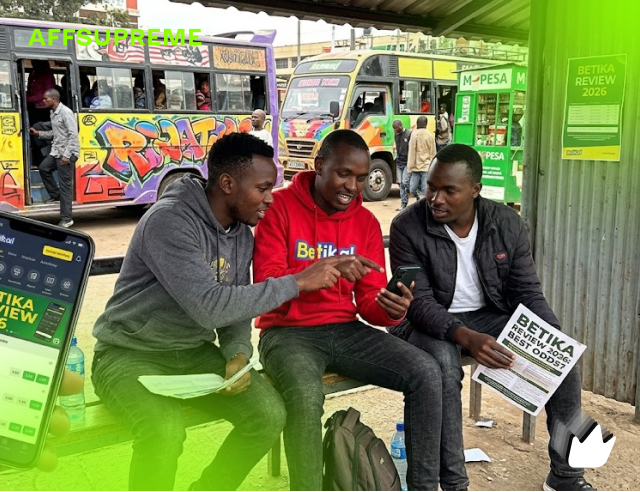
Betika Review 2026: Licence, Jackpots, M-Pesa Payouts & App
Our Betika review for October 2026 looks at Kenya’s best-known home-grown bookmaker. Betika was founded in Nairobi in 2016, is owned by Shop and Deliver Limited, and has grown into a pan-African brand. In Kenya it’s best known for its 17-game Grand Jackpot, M-Pesa paybill 290290, a lightweight Betika Lite site and heavy investment in local sport.
This review focuses on Kenya, with a section on Betika’s sites in Ghana and Uganda. It covers the licence and Kenya’s 2026 licensing transition, promotions, jackpots, the sportsbook, casino, payments, taxes, app, support, and the data-protection questions Betika has faced. Every fact is checked against a source, and where sources disagree we say so.
Advertising disclosure: AffSupreme may earn a commission when you sign up through links on this page. This never changes our assessment, and we only review operators licensed in the country concerned. Gambling is for adults 18+ and involves financial risk.
📌 Betika at a glance
- Run in Kenya by Shop and Deliver Limited, which held bookmaker licence BK 0001117 and public gaming licence PG 0001113 on the 2025/26 register.
- Kenya’s regulator, the Gambling Regulatory Authority (GRA), hadn’t published its 2026 register by mid-October 2026, so confirm Betika’s current licence before you deposit.
- No standing welcome bonus in Kenya, according to The Game Haus in October 2026; the draw is the jackpots and small daily promotions.
- Grand Jackpot: 17 games for KES 99, with bonus prizes from 12 correct. A 22-year-old student won KES 200 million in 2022.
- Deposits by M-Pesa paybill 290290. Kenyan law takes 5% excise from each deposit and 5% withholding tax from each withdrawal.
⭐ Our verdict: 7.9/10
Betika is a strong everyday bookmaker for Kenyans who bet on football and jackpots from a phone. It has the country’s best-known jackpot, deep coverage of Kenyan football, simple M-Pesa payments, a Lite site for slow connections and a long record of supporting local sport. It loses points for the lack of a welcome bonus, small promotions, no native iPhone app, Kenya’s unresolved 2026 licensing picture and unresolved allegations about the use of leaked customer data.
✅ What we like
- ✅ Kenya’s best-known jackpot, from KES 99
- ✅ Simple M-Pesa paybill 290290
- ✅ Strong coverage of Kenyan football
- ✅ Betika Lite for slow connections
- ✅ Deposit limits you can set yourself
⚠️ What could be better
- ⚠️ No standing welcome bonus in Kenya
- ⚠️ 2026 licence not yet on a published register
- ⚠️ Data-protection complaints and allegations
- ⚠️ No native App Store app for iPhone
📋 Betika Kenya key facts
| Feature | Details |
|---|---|
| Operator | Shop and Deliver Limited, trading as Betika |
| Founded | April 2016, Nairobi |
| Chief executive | Mutua Mutava |
| Regulator | Gambling Regulatory Authority (formerly the BCLB) |
| Licences on the 2025/26 register | BK 0001117 (bookmaker), PG 0001113 (public gaming) |
| Website | betika.com/en-ke |
| M-Pesa paybill | 290290 |
| Welcome bonus | None standing (October 2026) |
| Grand Jackpot | 17 games, KES 99 stake |
| Midweek Jackpot | 13 games, KES 49 stake |
| Tax | 5% excise on deposits, 5% withholding tax on withdrawals |
| App | Android (Google Play and APK); web app for iPhone |
| Support | Live chat, support@betika.com, +254 729 290 290, X @betikaKe |
🏢 Betika’s story: from SMS bets to a pan-African brand
According to Wikipedia, Betika was founded in April 2016 and first took sports bets by SMS only, adding USSD betting soon after and launching online betting in August 2016. It’s headquartered in Nairobi, has about 500 employees, and is owned by Shop and Deliver Limited, a company with Kenyan shareholders. Its chief executive is Mutua Mutava.
Key moments
- November 2018: Brazilian football legend Ronaldinho became Betika’s brand ambassador.
- 2018–2021: title sponsor of Kenya’s National Super League, the second division.
- 2019: launched its community programme, Betika Na Community, supporting football, cricket, athletics, motorsport and other sports.
- 2020: began expanding into other African markets.
- 2021: sponsored James Kagambi’s climb of Mount Everest.
- 2022: launched a KES 200 million jackpot, which was won that December.
- July 2023: launched what Kenyans.co.ke described as Kenya’s first betting app on the Google Play Store.
- February 2026: sponsored five Kenyan golfers at the Magical Kenya Open with a combined KES 3.2 million, the third year in a row, The Standard reported.
Betika has also backed Kenyan Premier League clubs, including AFC Leopards, Police FC and Sofapaka, and rugby sevens, rally and rallycross. In September 2026, Blask data cited by iGaming Afrika gave Betika a 29.1% share of Kenyan betting brand searches, the largest of any operator.
🛡️ Betika licence in Kenya
Betika Kenya is operated by Shop and Deliver Limited. On the 2025/26 register, the most recent list published by Kenya’s regulator, it held bookmaker licence BK 0001117 and public gaming licence PG 0001113.
Kenya’s 2026 licensing transition
Kenya’s Gambling Control Act 2025 replaced the Betting Control and Licensing Board with the Gambling Regulatory Authority, and every operator has had to apply for a licence under new 2026 regulations. That process has been turbulent:
- 7 August 2026: the High Court suspended the new, much higher licence fees and capital requirements in a challenge by petitioners who argue the rules were passed without public participation, iGaming Expert reported.
- 24 August 2026: the court varied that order and allowed the GRA to collect the new fees while the case continues, according to Business Daily.
- 24 September 2026: licences issued under the old regime remained valid until this date, according to the GRA’s notice cited by iGaming Times.
- Mid-October 2026: the GRA still hadn’t published a register of licences granted under the new rules, and the court case was unresolved.
In October 2026, 254 News reported on a court application that referred to new 2026 licence numbers for Betika, issued in early October, while questioning how they were granted. Those are an applicant’s claims, not court findings, and the numbers haven’t appeared on a published GRA register.
🎁 Betika welcome bonus and promotions in Kenya
Is there a Betika welcome bonus?
Not a standing one. The Game Haus, updated in October 2026, says there’s no current Betika welcome bonus for new players in Kenya; instead, promotions are open to new and existing customers once your account is set up. Other websites describe small sign-up free bets that differ from one site to the next, so we can’t confirm any of them. Open the Promotions page after you register to see what’s live.
Regular promotions reported in October 2026
These are the promotions The Game Haus described. Betika says it can change bonus terms at any time, so treat them as a guide and read the live terms.
Daily first-deposit bonus
A small bonus on the first deposit of each day, worth a few shillings, depending on the amount you deposit.
Lost Multibet Freebet
If a multibet of at least eight selections, staked with at least KES 49 in cash, loses by one selection, part or all of the stake comes back as a free bet, up to KES 1,000.
Loyalty points
Points earned on bets at minimum odds of 4.99 can be turned into free bets, with a daily cap on the points you can collect.
Early cash out
Settle a bet before the final whistle to lock in a profit or cut a loss.
🏆 Betika jackpots
Jackpots are what most Kenyans know Betika for. You predict the result of every match on a list, picking 1 (home win), X (draw) or 2 (away win).
| Jackpot | Matches | Stake | When |
|---|---|---|---|
| Grand Jackpot | 17 | KES 99 | Weekly; results published from Sunday night |
| Midweek Jackpot | 13 | KES 49 | Midweek |
Source: Paybillke’s jackpot guides, 2026. The top prize changes from round to round, and bonus prizes are paid for getting 12 or more of the 17 Grand Jackpot games right. Check the current jackpot size on Betika before you play.
The KES 200 million winner
In December 2022, NTV Kenya reported that Eli Kipruto Rotich, a 22-year-old student at Jomo Kenyatta University of Agriculture and Technology, won KES 200 million on the Betika Grand Jackpot by predicting all 17 matches. It was the first time the jackpot had been won. After 20% withholding tax, he was expected to receive about KES 160 million. Wikipedia also records a later winner, Moses Kiprono, reported in February 2023.
How hard is it to win?
With three possible results per match, there are 317 = 129,140,163 possible combinations for 17 games. If you guessed at random, your chance of getting all 17 right would be about 1 in 129 million. Even a well-informed punter who’s right 60% of the time on each match has only about a 1 in 5,900 chance (0.617). That’s why jackpots should be a small, fun weekly stake, never a plan.
⚽ Betika sportsbook
Football is at the centre of Betika’s sportsbook, with around 20 sports in total, according to The Game Haus. Kenyan comparison site Paybillke found that Betika covers the Kenyan Premier League and lower Kenyan divisions more comprehensively than SportPesa, although SportPesa has deeper European football markets. It also reported that Betika’s platform handled Saturday Premier League traffic better.
Features
- Shikisha: Betika’s bet builder, which combines several markets from one match on one slip.
- Live betting: in-play markets on football and other sports, although live streaming is limited.
- Cash out: settle eligible bets early.
- Multibets: accumulators across matches, with the Lost Multibet Freebet as a safety net on long slips.
- Minimum stake: Kenya’s Gambling Control Act sets the minimum online stake at KES 20.
The Game Haus describes Betika’s odds as slightly above average, with tennis and in-play prices as strengths. If you bet mainly on the Premier League or Champions League, compare prices with another licensed bookmaker.
🎰 Betika casino and Aviator
Betika also offers casino games, crash games and virtuals under its public gaming licence. The Game Haus lists slots from providers including Pragmatic Play, live casino from Evolution, with roulette, blackjack, baccarat and game shows such as Crazy Time, plus keno. Aviator offers were among the highlights when Betika launched its Google Play app in 2023, and virtual games run around the clock.
💳 Betika deposits and withdrawals (M-Pesa)
Betika is built around M-Pesa. You deposit through paybill 290290, and winnings are paid back to the Safaricom number registered on your account.
How to deposit with M-Pesa
- Open M-Pesa. Choose Lipa na M-Pesa, then Pay Bill.
- Enter business number 290290.
- Enter the account. Paybillke says you can use “BETIKA” or your registered Safaricom number, written without spaces or a plus sign.
- Enter the amount and your M-Pesa PIN.
- Check the confirmation SMS. The recipient should read “BETIKA KENYA”. If it shows another name, the paybill may be a scam.
Paybillke reports that deposits usually reach your Betika wallet within one to five minutes. If yours hasn’t arrived after five minutes, contact Betika with your M-Pesa transaction code. Kenyan reviewers also list Airtel Money for deposits.
Withdrawals
Withdrawals go back to the M-Pesa line registered on your account, and Paybillke reports that they usually arrive within minutes. If a withdrawal stalls, the usual causes are incomplete verification, an amount below the minimum, an unmet bonus condition or a temporary system delay. If nothing arrives within an hour, contact support with the transaction details.
How Kenyan taxes affect your money
Kenyan law takes tax at both ends of your betting, and Betika deducts it automatically:
| When | Tax | Example |
|---|---|---|
| Deposit | 5% excise duty | Deposit KES 100, and KES 95 reaches your wallet |
| Withdrawal | 5% withholding tax | Withdraw KES 1,000, and KES 950 reaches M-Pesa |
Because both taxes apply, a KES 1,000 deposit that you withdraw without betting would come back as about KES 902 (KES 950 credited, then KES 47.50 withheld on withdrawal). Deposit only what you plan to bet, and avoid moving money in and out often.
📱 Betika app and Betika Lite
Android
Betika’s Android app is on Google Play, published by Shop and Deliver Limited, and Paybillke recommends that route. It’s about 20 MB, and updates install automatically. You can also download an APK from betika.com if Google Play isn’t available on your phone. Only download it from Betika’s own site, as third-party APK sites can carry malware.
iPhone
Paybillke reports that Betika Kenya has no app on the App Store. Instead, open betika.com in Safari, tap Share and choose Add to Home Screen. The web app handles deposits, withdrawals, live betting and jackpots.
Betika Lite
Betika Lite is a stripped-down version of the site for slow connections and older phones. It’s designed for 2G and 3G connections, and AfricaSoccer notes that the Lite version of Betika’s Ghanaian site leaves out heavier features such as the casino and live streaming. If data costs or patchy coverage are a problem, it’s one of Betika’s most useful features.
💬 Betika customer support
- Live chat: on betika.com.
- Email: support@betika.com.
- Phone: +254 729 290 290, according to Paybillke.
- X (Twitter): @betikaKe.
- Responsible gambling hotline: 0800 724835, as listed by Paybillke.
When you contact support about a payment, give your M-Pesa transaction code first; it’s the fastest way to have a missing deposit or withdrawal traced. Report a fake paybill or suspicious SMS to Safaricom on 100.
🧭 Betika responsible gambling tools
Betika lets you manage your play from your account. Paybillke reports that you can set daily, weekly or monthly deposit limits in the Responsible Gaming section of My Account, and that raising a limit is subject to a cooling-off period of 24 to 72 hours, so you can’t increase it on impulse. Kenya’s Gambling Control Act also requires operators to give players deposit, loss and session limits.
- Open My Account. Go to the Responsible Gaming section.
- Choose a limit period. Daily, weekly or monthly.
- Enter an amount you can afford to lose. Lower limits apply straight away; increases wait for the cooling-off period.
- Ask support about a break. If you need time away, ask about self-exclusion, or contact the GRA on 0800 723 770.
⚖️ Betting law in Kenya and what it means for Betika users
Kenya replaced its old betting law with the Gambling Control Act 2025, which came into force on 26 August 2025. According to iGaming Times, the Act and its regulations:
- replace the Betting Control and Licensing Board with the Gambling Regulatory Authority;
- require at least 30% Kenyan ownership of licensed operators;
- set a minimum online stake of KES 20;
- require winnings to be paid within two days;
- ban credit cards and cryptocurrency for gambling;
- require KYC checks before an account is activated and before the first deposit;
- require operators to offer deposit, loss and session limits.
For Betika users, the practical effect is that you’ll verify your identity before you play, pay with M-Pesa or another local mobile method, and have the right to set limits on your account.
Taxes
From 1 July 2026, the Finance Act widened the 5% excise duty on gambling deposits, and a 5% withholding tax applies to amounts paid out to players. Some websites also describe a 20% withholding tax on all betting winnings from July 2026, but iGaming Times, which works from the statutes, lists the 20% rate only for lottery and prize competition payouts, so we haven’t included it in the table above.
🔐 Betika and data protection
Betika has faced two separate data-protection issues. Here’s what’s been decided and what’s only alleged.
Decided: an excessive account-closure demand
In 2025, a Betika customer complained to the Office of the Data Protection Commissioner after Betika asked for his national ID and three months of M-Pesa statements to close his account. Focus Gaming News reported in October 2025 that the commissioner found the ID request justified under anti-money laundering law but the M-Pesa statements “intrusive, unnecessary and disproportionate”, and ordered Betika to pay KES 250,000 in compensation and delete his data. Betika had 30 days to appeal.
Alleged: leaked Safaricom data
On 13 May 2026, the High Court ruled in Constitutional Petition E095 of 2026 that Safaricom had violated subscribers’ rights after employees extracted subscriber data over several years and supplied it to third-party betting firms. 254 News reported in August 2026 that a complainant had asked the GRA to suspend the licences of Betika and another bookmaker, citing a police forensic report that allegedly named them as buyers, and that the GRA confirmed it was investigating betting firms over the alleged data purchases.
These are allegations, not findings against Betika. The court’s judgment was against Safaricom, and 254 News reported that the firms named didn’t respond to its questions. We’ll update this review if the GRA announces an outcome.
🏛️ Payout disputes and the courts
Betika has also been tested in court over payouts. In March 2025, Business Daily reported that the Court of Appeal rejected a punter’s second appeal in a KES 99 million payout dispute with Betika, ruling that betting litigation under the old Betting, Lotteries and Gaming Act ended at the High Court. The case is a reminder to read the betting rules, particularly on void and postponed matches, and to keep screenshots of your slips.
The 2022 jackpot shows how postponements work in practice: one of Eli Kipruto Rotich’s 17 games was postponed, and its outcome was decided by a public draw, which went his way.
🔒 Is Betika safe and legit?
Betika is a long-established, legitimate Kenyan bookmaker, but there are open questions you should know about.
Why we trust it
- Track record: operating since 2016, with famous, documented jackpot payouts.
- Licensed history: licences BK 0001117 and PG 0001113 on the 2025/26 register.
- Local ownership and investment: owned by a Kenyan-shareholder company, with years of sponsorship in Kenyan sport.
- Self-service limits: deposit limits in your account, with a cooling-off period before increases.
What to watch
- 2026 licence: not yet confirmed on a published GRA register.
- Data allegations: an open GRA investigation reported by 254 News.
- Data requests: the commissioner’s 2025 decision shows Betika has asked for more documents than needed; you can challenge excessive requests.
- Fake paybills: always check that M-Pesa shows “BETIKA KENYA” before you confirm.
🌍 Betika in other African countries
Wikipedia lists Betika in ten countries: Kenya, Tanzania, Ethiopia, DR Congo, Ghana, Nigeria, Mozambique, Zambia, Uganda and Malawi. Each runs on its own licence and site. These are the two we’ve checked:
🇬🇭 Ghana
Betika is on the Gaming Commission of Ghana register for sports betting and online casino, with a licence running from 1 January to 31 December 2026, like every Ghanaian licence. Ghanaian reviewers highlight a 400% ACCA Bonus on accumulator winnings, mobile money payments by MTN, Telecel and AirtelTigo from GHS 1, and USSD betting without data. There’s no tax on winnings in Ghana, since the 10% withholding tax was repealed with effect from 2 April 2025. Welcome offers are described differently across Ghanaian sites, so check the Promotions page.
🇺🇬 Uganda
In Uganda, Betika is run by Sportive Limited, which appears on the National Lotteries and Gaming Regulatory Board’s 2026 list, according to iGaming Times. ChampsBase tested Airtel payouts there, and Betika supports MTN and Airtel mobile money. Uganda introduced a 15% withholding tax on winnings from 1 July 2026.
🛠️ Common Betika problems and fixes
| Problem | What to try |
|---|---|
| M-Pesa deposit not showing | Wait five minutes, check the SMS says “BETIKA KENYA”, then send support your M-Pesa code |
| Withdrawal stuck | Complete verification, check the minimum, and make sure no bonus condition is pending |
| Free bet won’t apply | Free bets need odds of 4.99 or more and expire after 24 hours |
| App won’t install from Google Play | Very old Android phones may be incompatible; use the APK from betika.com or Betika Lite |
| Using an iPhone | Add betika.com to your home screen from Safari |
| Slow connection or expensive data | Switch to Betika Lite |
| Want to raise a deposit limit | Expect a 24–72 hour cooling-off period |
🎯 Who is Betika best for?
✅ A great fit if you…
- Play weekly jackpots
- Bet on Kenyan football
- Pay with M-Pesa and want simple deposits
- Have a slow connection or an older phone
⚠️ Look elsewhere if you…
- Want a welcome bonus
- Use an iPhone and want a native app
- Bet mostly on top European leagues and want the deepest markets
- Want a bookmaker with no open regulatory questions
🆚 Betika Grand Jackpot vs SportPesa Mega Jackpot
Betika’s Grand Jackpot and SportPesa’s Mega Jackpot are Kenya’s two best-known football jackpots, and they look similar on paper.
| Feature | Betika Grand Jackpot | SportPesa Mega Jackpot |
|---|---|---|
| Matches | 17 | 17 |
| Stake | KES 99 | KES 99 |
| Bonus prizes | From 12 correct | For 12 to 16 correct |
| Famous win | KES 200 million (December 2022) | The jackpot has passed KES 400 million |
The maths is the same for both: 17 matches with three outcomes each give 129,140,163 possible combinations. Neither jackpot is “easier” to win; the main differences are the prize pool at the time you play and the size of the bonus tiers. If you play both, set one weekly budget that covers both tickets.
🪪 Verifying your Betika account
Under Kenya’s Gambling Control Act, operators must check your identity before your account is activated and before your first deposit, and they can check again before paying out. In practice, that means your national ID and the Safaricom number registered in your own name. The data commissioner’s 2025 decision confirmed that asking for a national ID is justified under anti-money laundering law, but that a blanket demand for three months of M-Pesa statements to close an account was excessive.
- Use your own SIM. Your account and payouts are tied to the number you register with.
- Verify early. Unverified accounts are the most common reason withdrawals stall.
- Know your rights. Under Kenya’s Data Protection Act 2019, you can ask for your data to be deleted when you close your account, and complain to the Office of the Data Protection Commissioner if a request seems excessive.
🧩 Betika features explained
| Feature | What it does | Watch out for |
|---|---|---|
| Grand Jackpot | Predict 17 results for one KES 99 ticket | Postponed games can be settled by a public draw |
| Midweek Jackpot | Predict 13 results for KES 49 | Smaller top prize than the Grand Jackpot |
| Shikisha | Combine several markets from one match | All parts must win, and linked outcomes are priced together |
| Lost Multibet Freebet | Returns part or all of your stake as a free bet when a long multibet loses by one selection | Needs at least eight selections and a KES 49 cash stake; capped at KES 1,000 |
| Free bets | Bet without using your cash balance | Minimum odds of 4.99; expire after 24 hours; not withdrawable |
| Loyalty points | Earn points towards free bets | Only bets at odds of 4.99 or more count |
| Cash out | Settle a bet early | The cash-out value is usually below the full potential return |
| Betika Lite | A low-data version of the site | Fewer features than the full site |
🧮 Worked examples
Example 1: the Lost Multibet Freebet
You place a KES 100 cash multibet with 10 selections. Nine win and one loses. Under the terms reported by The Game Haus, a slip of 8–19 games that loses by one selection returns 100% of the stake as a free bet, so you’d receive a KES 100 free bet. You’d then need to use it on selections at odds of 4.99 or more within 24 hours.
Example 2: the real cost of moving money
You deposit KES 2,000, so KES 1,900 reaches your wallet after the 5% excise. You win and withdraw KES 3,000, so KES 2,850 reaches M-Pesa after the 5% withholding tax. Across the round trip, KES 250 went in tax. Fewer, planned deposits keep that cost down.
Example 3: why more legs aren’t better
Ten selections that each have a 70% chance of winning combine to under a 3% chance that all ten win (0.710 ≈ 0.028). The Lost Multibet Freebet softens near-misses, but it doesn’t change how unlikely long slips are to win.
🇰🇪 Betika and Kenyan football
Few bookmakers are as tied to Kenyan football as Betika. It was title sponsor of the National Super League from 2018 to 2021 and has backed top-flight clubs including AFC Leopards, Police FC and Sofapaka. That local focus shows in the sportsbook: Paybillke rated Betika’s coverage of the Kenyan Premier League and lower divisions more comprehensive than SportPesa’s.
For bettors, local leagues are where knowledge can matter most, but they’re also where information is thinnest. Team news can be hard to find, and prices on smaller leagues tend to carry higher margins than on Europe’s top divisions. Keep stakes modest and never bet on information you can’t verify.
🚨 How to avoid Betika scams
Betika’s popularity makes it a target for fraudsters. Protect yourself with these checks:
- Check the paybill name. The M-Pesa confirmation must name “BETIKA KENYA”. If it doesn’t, stop and report it to Safaricom on 100.
- Use only official apps. Get the Android app from Google Play or betika.com, never from WhatsApp links or APK mirror sites.
- Ignore “fixed match” and jackpot tip sellers. No one can guarantee football results, and anyone selling sure jackpot predictions is running a scam.
- Keep your PINs private. Never share your M-Pesa PIN, Betika password or one-time codes, even with someone who says they’re from support.
- Keep records. Save your M-Pesa transaction codes and screenshots of important slips.
⚖️ Betika pros and cons in detail
✅ Strengths
- Jackpot heritage. A 17-game Grand Jackpot from KES 99, with a documented KES 200 million winner.
- Built for Kenya. M-Pesa paybill 290290, SMS and USSD roots, Betika Lite and coverage of local football.
- Responsible gambling controls. Self-service deposit limits with a cooling-off period on increases.
- Community investment. Years of sponsorship in football, golf, athletics, rugby and motorsport.
⚠️ Weaknesses
- Thin promotions. No standing welcome bonus, and most promotions are small.
- Demanding free-bet rules. Odds of 4.99 or more and a 24-hour expiry.
- No native iPhone app. iPhone users rely on the web app.
- Open questions. An unpublished 2026 register and a reported GRA investigation into data allegations.
🗓️ Betika: key dates
| Date | Event |
|---|---|
| Apr 2016 | Betika founded in Nairobi, taking bets by SMS |
| Aug 2016 | Online betting launched |
| Nov 2018 | Ronaldinho becomes brand ambassador |
| 2018–2021 | Title sponsor of the National Super League |
| 2020 | Expansion into other African markets |
| Dec 2022 | Eli Kipruto Rotich wins the KES 200 million Grand Jackpot |
| Jul 2023 | Betika app launched on Google Play |
| Mar 2025 | Court of Appeal rejects a punter’s KES 99 million second appeal |
| 26 Aug 2025 | Gambling Control Act 2025 comes into force |
| Oct 2025 | Data commissioner orders KES 250,000 compensation over excessive document requests |
| Feb 2026 | Betika sponsors five golfers at the Magical Kenya Open |
| 13 May 2026 | High Court rules against Safaricom over leaked subscriber data |
| Aug 2026 | High Court suspends, then allows, the GRA’s new licence fees; GRA reported to be investigating data allegations |
| 24 Sep 2026 | Old-regime licences reach the end of their validity |
| Oct 2026 | Court application refers to Betika’s new 2026 licence numbers; GRA register still unpublished |
📝 How to register at Betika Kenya
- Go to betika.com/en-ke. Use the official site, the Google Play app or Betika Lite. You must be 18 or older.
- Sign up with your Safaricom number. Create a password; your account is tied to the SIM you register with.
- Verify your identity. Kenyan law requires KYC before your account is activated and before your first deposit.
- Set a deposit limit. Do it now in My Account → Responsible Gaming, before you bet.
- Deposit by M-Pesa. Use paybill 290290 and check that the SMS recipient reads “BETIKA KENYA”.
- Check the Promotions page. See which promotions are live, and read the free-bet rules.
- Place your bet. The minimum online stake in Kenya is KES 20.
⚖️ Betika vs other Kenyan bookmakers
| Bookmaker | Paybill | Standout | 2026 licence status |
|---|---|---|---|
| Betika | 290290 | Grand Jackpot, Kenyan football coverage, Betika Lite | 2026 numbers referred to in a court application; not on a published register |
| SportPesa | 955100 | 17-game Mega Jackpot, deeper European football markets | Displays a GRAK/2026 licence number on its site |
| SportyBet | 590555 | Fast app, 1,000% Multi Bet Bonus, cash out | 2025/26 register numbers; 2026 not yet confirmed |
All three were on the 2025/26 register. Betika wins on jackpots and local football, SportPesa on European markets and SportyBet on its app and accumulator bonus. Whichever you choose, confirm the current licence with the GRA.

🧪 How we reviewed Betika
This Betika review is based on Kenya’s published licence register, court and regulatory reporting by Business Daily, iGaming Expert, iGaming Times, Focus Gaming News and 254 News, and independent guides and reviews published in 2026, including Paybillke, The Game Haus, Football Whispers and AfricaSoccer. Where sources disagreed, for example on Betika’s welcome offer, minimum deposit and withdrawal, iPhone app and Kenyan tax on winnings, we left the detail out or explained the disagreement. We describe allegations as allegations.
- 25%🛡️ Licensing and safety. Licence status, regulatory record and data protection.
- 20%⚽ Sportsbook and jackpots. Football coverage, jackpots and features.
- 20%💳 Payments. M-Pesa deposits, payout speed and tax.
- 15%🎁 Bonuses. Welcome offer and regular promotions.
- 10%📱 App. Android app, iPhone access and Betika Lite.
- 10%💬 Support and RG tools. Channels and limits.
🧘 Responsible gambling in Kenya
Betting should be entertainment, never a way to make money. Jackpots in particular are long shots: only stake what you can afford to lose.
Warning signs
- Thinking about betting all the time or planning the next slip.
- Chasing losses or borrowing money, including mobile loans, to bet.
- Hiding betting from family or lying about how much you spend.
- Betting to escape stress or bad feelings.
Where to get help
- Gambling Regulatory Authority helpline: 0800 723 770.
- Betika responsible gambling hotline: 0800 724835, as listed by Paybillke.
- Betika’s own tools: deposit limits in My Account, with a cooling-off period before any increase.
- More services: Find A Helpline.
🔞 18+ only. Never let anyone under 18 use your betting account or your M-Pesa line.
❓ Frequently asked questions
Is Betika licensed in Kenya?
Betika’s operator, Shop and Deliver Limited, held bookmaker licence BK 0001117 and public gaming licence PG 0001113 on the 2025/26 register. Old-regime licences were valid until 24 September 2026, and the GRA hadn’t published its 2026 register by mid-October 2026, so confirm the current licence at gra.go.ke or on 0800 723 770.
Who owns Betika?
Betika is owned by Shop and Deliver Limited, a company with Kenyan shareholders. It was founded in Nairobi in April 2016, and its chief executive is Mutua Mutava.
What is the Betika paybill number?
290290. Use “BETIKA” or your registered Safaricom number as the account, and check that the confirmation SMS reads “BETIKA KENYA”.
Does Betika have a welcome bonus?
Not a standing one in Kenya, according to The Game Haus in October 2026. Betika runs regular promotions for all customers, such as a small daily first-deposit bonus and the Lost Multibet Freebet.
How much does the Betika Grand Jackpot cost?
KES 99 per ticket for 17 matches. The Midweek Jackpot has 13 matches for KES 49. Bonus prizes are paid from 12 correct predictions on the Grand Jackpot.
Has anyone won the Betika Grand Jackpot?
Yes. In December 2022, student Eli Kipruto Rotich won KES 200 million, receiving about KES 160 million after 20% withholding tax. Wikipedia records a later winner, Moses Kiprono, reported in February 2023.
What taxes does Betika deduct?
5% excise duty on each deposit and 5% withholding tax on each withdrawal, as required by Kenyan law.
How long do Betika withdrawals take?
M-Pesa withdrawals usually arrive within minutes. If a withdrawal hasn’t arrived within an hour, contact support with your transaction details.
Is the Betika app on Google Play?
Yes. The Android app is on Google Play from Shop and Deliver Limited, and an APK is available from betika.com. iPhone users can add betika.com to their home screen from Safari.
What is Betika Lite?
A lightweight version of Betika’s site for slow connections and older phones, which uses less data than the full site.
What is Shikisha on Betika?
Shikisha is Betika’s bet builder, which lets you combine several markets from one match on one slip.
How do I set a deposit limit on Betika?
Go to My Account → Responsible Gaming and choose a daily, weekly or monthly limit. Lowering a limit works straight away; raising it is subject to a 24–72 hour cooling-off period.
How do I contact Betika customer care?
Use live chat on betika.com, email support@betika.com, call +254 729 290 290 or message @betikaKe on X.
What is the minimum stake on Betika Kenya?
Kenya’s Gambling Control Act sets the minimum online stake at KES 20, so that’s the lowest bet you can place on a sportsbook slip. Jackpot tickets have their own fixed prices: KES 99 for the Grand Jackpot and KES 49 for the Midweek Jackpot.
What is the Betika Lost Multibet Freebet?
A promotion that returns part or all of your stake as a free bet when a multibet of at least eight selections, staked with at least KES 49 in cash, loses by one selection. The free bet is capped at KES 1,000, according to The Game Haus.
Is Betika available outside Kenya?
Yes. Betika runs separate licensed sites in several African countries, including Ghana, where it’s on the Gaming Commission of Ghana’s 2026 register, and Uganda, where Sportive Limited is on the 2026 list.
🏁 Final verdict: our Betika review
Betika has earned its place as Kenya’s best-known betting brand. Its Grand Jackpot is a weekly ritual for many Kenyans, its coverage of local football is excellent, M-Pesa payments are simple, Betika Lite keeps it usable on any connection, and its deposit limits are easy to set yourself.
But this isn’t a review without caveats. There’s no standing welcome bonus, promotions are small, iPhone users have only a web app, and two bigger questions are still open: Kenya’s 2026 licence register hasn’t been published, and the GRA is reported to be investigating allegations about leaked customer data. Neither has produced a finding against Betika, but both are worth watching.
Our advice: confirm the licence with the GRA, register on the official site, set a deposit limit, check the paybill name every time you deposit, and keep your jackpot stakes small. We’ll update this Betika review when the GRA publishes its 2026 register or announces the outcome of its investigation.
Our overall score: 7.9/10.
Join Betika Kenya 18+ | T&Cs apply | Gamble responsibly