
Choosing the right domain is one of the most important steps when launching an affiliate website. Your domain influences branding, SEO performance, trust, click-through rates, and long-term scalability. A strategically selected domain helps you build authority and increase affiliate revenue over time.
This guide explains how to choose a domain for an affiliate site that is SEO-friendly, brandable, and built for sustainable growth.
Why Your Domain Name Matters for Affiliate Marketing
Your domain functions as:
-
Your brand identity
-
A trust signal for visitors
-
An indirect ranking factor
-
A long-term digital asset
A poorly selected domain can limit growth and reduce credibility. A strong domain supports authority building and improves user perception.
1. Decide Between a Niche-Focused or Brandable Domain
When selecting a domain for an affiliate website, there are two main strategic approaches.
Niche-Focused or Keyword-Oriented Domain
This type of domain includes keywords related to the niche. It can immediately communicate the website’s topic and may improve click-through rates in search results.
However, keyword-heavy domains can appear overly optimized and may limit future expansion into broader categories.
Brandable Domain (Recommended for Long-Term Growth)
A brandable domain focuses on uniqueness and memorability rather than exact keywords. It provides stronger long-term branding potential and allows flexibility when expanding into new product categories.
For sustainable affiliate businesses, brandable domains are generally the preferred strategy.
2. Keep It Short, Memorable, and Easy to Spell
User behavior plays a major role in SEO performance. A domain that is difficult to spell, pronounce, or remember can reduce direct traffic and backlinks.
Best practices:
-
Keep the name concise
-
Avoid hyphens and numbers
-
Use simple spelling
-
Ensure it is easy to pronounce
Clarity and simplicity improve recall and brand recognition.
3. Use Keywords Strategically
Exact match domains are no longer as powerful as they once were. However, including a relevant keyword can still provide contextual relevance and improve click-through rates.
The key is balance. Avoid excessive keyword stuffing in the domain name. A clean and professional structure is more important than forcing multiple keywords into the URL.
4. Choose the Right Domain Extension
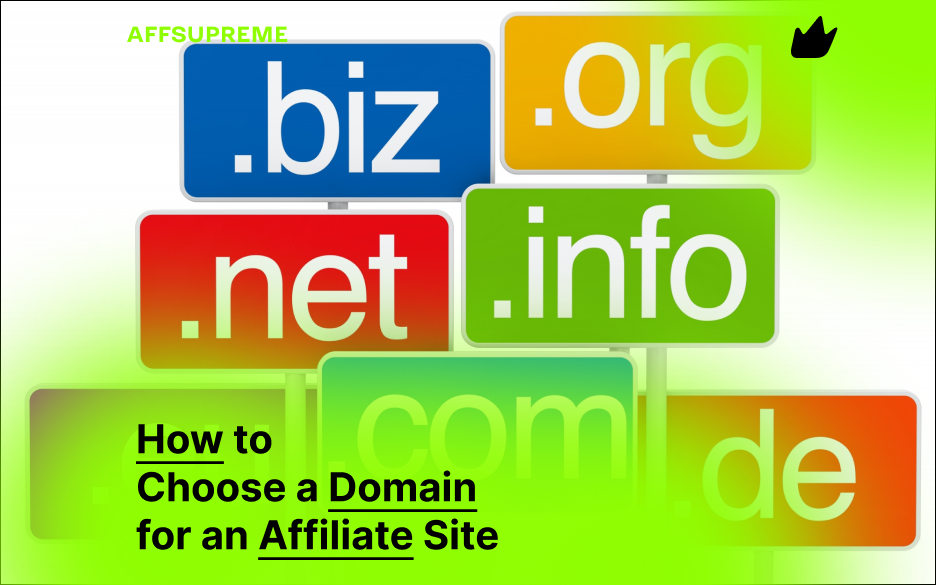
The .com extension remains the most trusted and widely recognized domain extension globally. If available, it is generally the best choice for an affiliate site.
Alternative extensions such as .net, .co, .io, or niche-specific extensions may be suitable when:
-
The .com version is unavailable
-
The extension aligns with your niche
-
You are building a strong brand identity
For country-specific affiliate projects, a local country-code domain can improve regional trust and relevance.
5. Check the Domain History
Before purchasing a domain, investigate its history. This step is critical for SEO.
Review:
-
Previous ownership
-
Backlink profile
-
Potential penalties
-
Spam history
Domains previously associated with spam, low-quality link networks, or unrelated industries can negatively affect rankings. A clean history reduces risk and supports stable growth.
6. Avoid Trademark Violations
Ensure your domain does not infringe on registered trademarks. Including brand names in your domain can lead to legal disputes and potential loss of the domain.
Before registering, search official trademark databases and confirm that your chosen name is legally safe.
7. Think Long-Term and Scalable
Your domain should support future growth. Consider whether you may expand into additional product categories or transform the site into a broader authority platform.
Choosing a flexible and scalable domain protects your long-term business potential and increases resale value.
8. Check Social Media Availability
Brand consistency across platforms strengthens authority and recognition. Before registering your domain, verify that matching social media usernames are available.
Unified branding supports long-term visibility and marketing efforts.
9. Consider an Aged Domain Carefully
An aged domain can offer advantages such as existing backlinks and established trust signals. However, it should only be purchased after a thorough analysis of its backlink profile and historical use.
If the domain was previously penalized or used for low-quality practices, it can harm your project rather than help it.
10. Final Checklist Before Purchasing
Before buying your domain, confirm:
-
It is easy to spell and remember
-
It is brandable and professional
-
It allows future expansion
-
It has a clean history
-
It does not violate trademarks
-
The preferred extension is available
-
Social media handles are accessible
Meeting these criteria increases the likelihood of long-term success.
Conclusion
Choosing a domain for an affiliate site is a strategic decision that directly affects branding, SEO, user trust, and revenue potential.
A well-selected domain builds authority, improves conversion rates, and supports business growth. Take time to research, evaluate long-term goals, and choose a domain that reflects a serious and scalable affiliate project.