


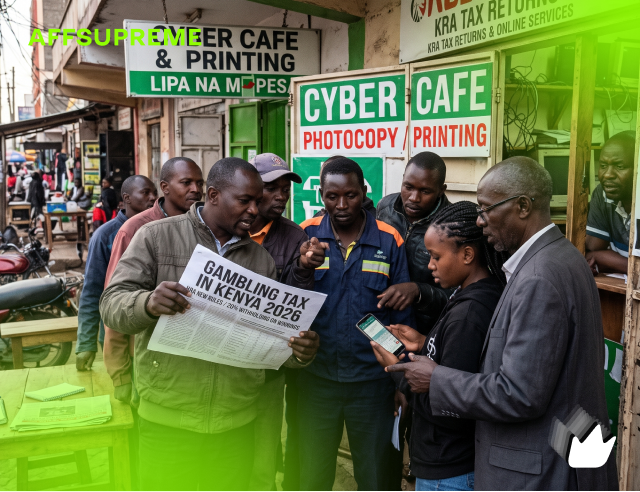
Gambling Tax in Kenya 2026: Deposit Excise, Withdrawal Tax and the 20% Winnings Tax Explained
How much gambling tax in Kenya do you pay in 2026? The rules have changed twice in two years. The Finance Act 2025 scrapped the old 20% tax on winnings and replaced it with 5% on deposits and 5% on withdrawals. Then the Finance Act 2026, signed on 23 June 2026, brought back a 20% withholding tax on “winnings”, widened the deposit tax and moved the point at which withdrawal tax is charged.
This guide explains every tax that affects Kenyan bettors from 1 July 2026, with worked examples in Kenyan shillings, the history of each rate, the debate over whether the new 20% applies to sports betting, what operators pay, and how Kenya compares with its neighbours. Every rate is checked against tax-firm analysis and 2026 reporting.
Disclaimer: this guide explains Kenyan gambling tax for general information and isn’t tax advice. Advertising disclosure: AffSupreme may earn a commission when you sign up through links on this page.
📌 Key takeaways
- 5% excise duty on deposits: from 1 July 2026, it applies to any amount deposited for betting or gaming, and horse racing is no longer excluded.
- 5% withholding tax on withdrawals: now charged when a payout is credited to your betting account, rather than when you move money to M-Pesa.
- 20% withholding tax on winnings: reintroduced by the Finance Act 2026. The law defines “winnings” as payouts from a lottery or prize competition; sources disagree on whether it also covers sports betting.
- No tax on the stake itself since the Finance Act 2025 removed the old excise on amounts wagered.
- Operators handle it: licensed operators deduct the taxes and pay them to KRA, so you don’t declare them yourself.
- Operators pay more: 15% on gaming revenue, 30% corporation tax and 15% excise on gambling adverts.
📋 Kenya gambling tax at a glance (from 1 July 2026)
| Tax | Rate | Charged on | Who pays / deducts |
|---|---|---|---|
| Excise duty on betting and gaming | 5% | Any amount deposited for betting or gambling | Bettor; deducted by operator |
| Withholding tax on withdrawals | 5% | Amounts paid or disbursed to the player’s account | Bettor; deducted by operator |
| Withholding tax on winnings | 20% | “Winnings”: payouts from a lottery or prize competition (scope debated) | Bettor; deducted by operator |
| Tax on stakes | None | — | — |
| Gaming revenue / turnover tax | 15% | Operators’ gaming revenue | Operator |
| Corporation tax | 30% | Taxable profits | Operator |
| Excise on gambling advertising | 15% | Advertising fees | Advertiser |
🧾 The three taxes Kenyan bettors pay
As a bettor in Kenya, you don’t file a tax return for your bets. Instead, licensed operators deduct tax automatically at three points: when you deposit, when money is paid out to your betting account, and (for some payouts) when you win. Here’s how each one works.
1. 5% excise duty on deposits
Every time you deposit money to bet or gamble, 5% goes to the Kenya Revenue Authority as excise duty. Before July 2026, the Finance Act 2025 charged this on money moved from a mobile money wallet into a betting account. The Finance Act 2026 kept the 5% rate but replaced that “wallet-based charging mechanism with a broader charge on amounts deposited for betting purposes”, EY reported, and removed the old exclusion for horse racing. PwC describes the new base as “any amount deposited or otherwise made available for betting or gambling purposes”.
In practice, Paybill KE explains: “A KES 100 deposit from M-PESA reaches the wallet as KES 95.” The M-Pesa paybill fee, if any, is separate.
2. 5% withholding tax on withdrawals
The Finance Act 2025 replaced the old 20% tax on winnings with a 5% withholding tax on withdrawals from betting and gaming wallets. It applies whether or not you’ve won: the Star reported that a player who deposits KSh 1,000 and withdraws it without betting would lose KSh 50.
The Finance Act 2026 changed when this tax is charged. It redefined “withdrawals” as “the amount of money, cash equivalent or money’s worth paid or disbursed to the player’s account”, which EY says moves the tax point to when the amount is paid out and “closes a deferral loophole”. Paybill KE puts it simply: the tax point moved to when a payout is credited to your account, not when you move money to M-Pesa.
3. 20% withholding tax on winnings
The Finance Act 2026 “reintroduced withholding tax on winnings at the rate of 20% for both resident and nonresident persons”, according to EY. The key question is what counts as “winnings”. The Act defines them as “a pay-out from a lottery or prize competition by a person licensed under the Gambling Control Act, 2025”.
No tax on stakes
Until June 2025, Kenya charged excise duty on the amount you staked on each bet. The Finance Act 2025 removed it, and Paybill KE confirms that in 2026 “there is no tax on the stake”. You’re taxed when money goes in and when it comes out, not on each bet you place.
🧮 Worked examples
These examples show how the 5% taxes affect typical transactions. They assume a Kenyan-licensed operator and leave out M-Pesa fees.
| Scenario | Calculation | Result |
|---|---|---|
| Deposit KES 1,000 | KES 1,000 − 5% excise (KES 50) | KES 950 in your betting balance |
| KES 2,000 paid out to your account | KES 2,000 − 5% withholding (KES 100) | About KES 1,900 available to withdraw |
| Deposit KES 1,000, don’t bet, withdraw everything (Finance Act 2025 rules) | KES 950 after excise, then 5% on withdrawal (about KES 47.50) | About KES 902.50 back; treatment under the 2026 definition may differ |
| Deposit KES 500, win a bet worth KES 2,000 and withdraw it | KES 25 excise on deposit; 5% on the KES 2,000 payout when it’s credited (KES 100) | About KES 1,900 received; KES 125 in total tax |
Illustrations only. Operators may round amounts or apply the withdrawal tax at a slightly different point under the 2026 definition; your account statement shows the exact deductions.
Where the 20% applies
Paybill KE cites an example reported by Kenyans.co.ke: under the 20% winnings tax, a KSh 100,000 win pays KSh 80,000, with KSh 20,000 going to KRA. Paybill KE doesn’t show how the 20% and 5% would stack on the same payout, because commentary differs, so we haven’t calculated a combined figure either.
For perspective, under the old 20% regime, the student who won Betika’s KES 200 million jackpot in December 2022 received about KES 160 million after tax, NTV Kenya reported.
📅 How Kenya’s gambling taxes have changed
| Period | Excise duty | Withholding tax |
|---|---|---|
| Finance Act 2021 | 7.5% on betting | 20% on winnings |
| Finance Act 2022 | 7.5%; horse racing exempted | 20% on winnings |
| Finance Act 2023 | Raised to 12.5% on amounts staked | 20% on winnings |
| Until June 2025 | 15% on amounts wagered (iGaming Business) | 20% on net winnings |
| Finance Act 2025 (from 1 July 2025) | 5% on deposits from mobile wallets | 5% on withdrawals; 20% winnings tax repealed |
| Finance Act 2026 (from 1 July 2026) | 5% on any amount deposited for betting or gaming; horse racing included | 5% on amounts paid to the player’s account; 20% on “winnings” reintroduced |
Earlier rates are from MMS Advocates’ June 2026 summary and iGaming Business; MMS’s own text isn’t fully consistent on the pre-2025 excise rate.
🔄 The 2025 switch: winners paid less, everyone else paid more
The Finance Act 2025 changed who bears the tax. Under the old rules, the 20% fell mainly on winners. Under the new 5%/5% model, everyone pays on deposits and withdrawals, whether they win or lose. iGaming Business quoted one analyst: “Now, all bettors will pay 5% on deposits and withdrawals, regardless of whether they win or lose.” It calculated that a bettor withdrawing KSh 10,000 now pays KSh 500, compared with KSh 1,500 to KSh 2,000 under the old system.
The government expected revenue to rise anyway. The Parliamentary Budget Office projected gambling tax collections nearly doubling, from about KSh 5.4 billion to KSh 11.4 billion, Business Daily reported in October 2025. The PBO also warned that the withdrawal tax could charge players who had earned nothing and push some away from regulated platforms.
🏛️ The Finance Act 2026 debate
- 30 April 2026: the Finance Bill 2026 was tabled, proposing to reinstate a 20% withholding tax on winnings for residents and non-residents, alongside the 5% taxes, and to treat chips, tokens and credits as taxable deposits, Parameter reported.
- 25 May 2026: public participation closed.
- 26 May 2026: the Gambling Regulatory Authority opposed key provisions before the National Assembly’s Finance Committee, according to MMS Advocates.
- 23 June 2026: President Ruto assented to the Finance Act 2026, EY reported.
- 1 July 2026: the changes took effect, according to PwC and Paybill KE.
Opponents warned that reviving the 20% tax could push bettors to offshore and unlicensed sites, Parameter reported. Paybill KE notes that some earlier coverage wrongly said the 20% had been scrapped in 2026; that was only true under the 2025 Act.
📜 A decade of betting tax battles in Kenya
Kenya’s betting taxes have changed almost every year since 2019, and each change has reshaped the industry. Business Today’s July 2026 review of the sector sets out the sequence:
- 2019: the Finance Act 2019 introduced a 20% excise duty on stakes alongside withholding tax on winnings. SportPesa temporarily closed its Kenyan operations in 2019 before returning through another company; it relaunched in October 2020.
- 2020: the excise duty on stakes was removed.
- 2021: excise was restored at 7.5%.
- 2023: excise rose to 12.5%.
- Early 2025: excise increased to 15% of the amount wagered.
- July 2025: the Finance Act 2025 cut excise to 5% on deposits and replaced the 20% winnings tax with 5% on withdrawals.
- July 2026: the Finance Act 2026 widened both 5% taxes and reintroduced a 20% withholding tax on “winnings”.
Some operators have left Kenya citing high taxes: Betsafe joined a list of firms exiting the market, and Betway stopped taking Kenyan deposits in May 2023.
📖 The legal definitions that decide your tax
Small changes in wording have big effects on what you pay. Here’s how the key terms have been defined:
| Term | Finance Act 2025 (from 1 July 2025) | Finance Act 2026 (from 1 July 2026) |
|---|---|---|
| Deposit (excise base) | “the amount of money transferred by a customer” into a betting wallet | Any amount deposited or otherwise made available for betting or gambling, whether or not held in a wallet |
| Withdrawals | “the amount of money withdrawn by a customer from their betting or gaming wallet” | “the amount of money, cash equivalent or money’s worth paid or disbursed to the player’s account” |
| Winnings | Definition repealed | “a pay-out from a lottery or prize competition by a person licensed under the Gambling Control Act, 2025” |
| Horse racing | Excluded from betting excise | Exclusion removed |
Definitions as quoted by SiGMA (2025 Act) and EY and PwC (2026 Act).
⚖️ Who pays more under each system?
The switch from taxing winnings to taxing money flows changed who carries the burden. Here’s an illustration for three types of bettor over a month, comparing the old system (15% excise on stakes and 20% on net winnings, as in early 2025) with the 2025 system (5% on deposits and 5% on withdrawals). It ignores the 2026 changes and M-Pesa fees, and assumes each bettor stakes their whole deposit once and that the old excise applied to the full amount staked.
| Bettor | Activity | Old system (approx.) | 2025 system (approx.) |
|---|---|---|---|
| Casual loser | Deposits KES 2,000, loses it all | KES 300 excise (15% of KES 2,000 staked) | KES 100 excise on deposits |
| Small winner | Deposits KES 2,000, ends with KES 3,000 and withdraws it | KES 300 excise + KES 200 (20% of KES 1,000 net winnings) = KES 500 | KES 100 on deposit + KES 150 on withdrawal |
| Big winner | Deposits KES 1,000, wins KES 100,000 and withdraws it | KES 150 excise + about KES 19,800 (20% of KES 99,000 net winnings) | KES 50 + KES 5,000 |
Simplified illustration only; the exact old-system figures depended on how operators applied excise and defined net winnings.
The pattern is clear: in these examples, the 2025 system was much cheaper for big winners and cheaper for casual bettors, but it taxed every withdrawal, including money that hadn’t been won. The 2026 reintroduction of a 20% tax on “winnings” moves part of the burden back towards winners, at least for lotteries and prize competitions.
📉 How taxes affect odds, bonuses and promotions
Taxes don’t just show up as deductions. Business Today’s July 2026 analysis describes how operators have responded to Kenya’s tax changes:
- Fewer big sign-up bonuses: operators are shifting from broad welcome offers to cashback, loyalty programmes, odds boosts and rewards based on verified activity. The Gambling Control Act’s instruction to “refrain from offering inducements” points the same way.
- Higher margins: higher tax costs mean bookmakers build bigger margins into their odds and offer fewer promotional enhancements, so prices may be less competitive.
- More automation: operators use real-time ledgers to reconcile deposits, withdrawals, winnings and the daily excise remittance.
- Consolidation: smaller operators face higher unit costs and may be sold, merge or exit.
For bettors, the practical effect is that the “real” cost of betting includes both the visible 5% taxes and slightly lower odds. Comparing odds between two licensed apps before a big bet is a simple way to claw some of that back.
🔍 How to check the tax deducted from your account
- Open your betting app’s transaction or account history, not just your M-Pesa messages.
- Find each deposit: it should show the amount sent and the amount credited after 5% excise.
- Find each payout: from July 2026, look for the 5% withholding deducted when the payout was credited, and any 20% deduction on qualifying winnings.
- Compare with your M-Pesa statement to check the totals match.
- Ask support if a deduction doesn’t make sense, and keep the reply.
- Save statements for big wins, in case you need to show the source of funds later.
🏦 KRA’s approach: real-time monitoring
KRA has been connected to betting firms’ systems since October 2022, which lets it see deposits, withdrawals and payouts in real time, according to MMS Advocates. When the Finance Act 2025 changes took effect, KRA wrote to operators thanking them for their “support in our objective to enhance tax compliance” and encouraging them “to continue with the same spirit of voluntary compliance”, SiGMA reported. Operators that fail to remit can face fines and, under the Gambling Control Act framework, suspension of their licence.
🧠 Tax and responsible gambling
The 5% on every deposit makes chasing losses even more expensive: each top-up loses 5% before you place a bet. If you find yourself making repeated small deposits in one session, it’s a sign to stop. Use your operator’s deposit limits, which licensed operators must offer, and remember that the GRA’s self-exclusion programme can block you from all licensed operators for 6 months to 5 years.
🔮 What could change next?
- The scope of the 20% tax: with tax firms reading it differently, KRA guidance or a future Finance Act may clarify whether ordinary sports bets count as “winnings”.
- Annual Finance Bills: Kenya’s gambling taxes have changed almost every year since 2019, so watch the Finance Bill each April to June.
- Licensing fees: the High Court case over the GRA’s licence fees (JR E251 of 2026) was still pending in October 2026.
- GRA versus Treasury: the regulator opposed the 2026 tax changes as impractical, according to Business Today, so further debate is likely.
🔬 How we researched this guide
Kenya’s gambling taxes are often misreported, partly because they changed in both 2025 and 2026. To get this right, we relied on:
- Tax-firm analysis: EY’s summary of the Finance Act 2026 (assented 23 June 2026), PwC’s Worldwide Tax Summaries page for Kenya (last reviewed 17 July 2026) and MMS Advocates’ June 2026 overview of betting taxation.
- Industry reporting: SiGMA on the Finance Act 2025 definitions, iGaming Business and SBC News on the 5%/5% model, Business Daily on revenue projections, Parameter on the Finance Bill 2026, and Business Today on how operators have responded.
- Practical guides: Paybill KE’s October 2026 betting tax guide for how deductions appear to bettors.
Where sources disagree, as they do on whether the 20% tax covers ordinary sports betting, we show each view rather than pick one. Tax rules can change with each annual Finance Act, so check your operator’s statement and KRA guidance for the latest position.
🏢 Taxes paid by betting operators
Operators carry their own tax burden on top of the taxes they collect from players:
| Tax | Rate | Notes |
|---|---|---|
| Gaming revenue tax | 15% | MMS Advocates describes 15% on net gambling revenue under section 29A and the Gambling Control Act 2025 framework; PwC describes a 15% turnover tax on lottery and gaming under the Betting, Lotteries and Gaming Act |
| Corporation tax | 30% | On taxable profits |
| Excise on advertising | 15% | On gaming advertisements on TV, print, billboards and radio (Finance Act 2023) |
| Licence fees | KES 50 million for an online bookmaker or casino licence, plus a KES 5 million application fee | Under the 2026 licensing regulations, Techweez reported; fees challenged in court |
How operators collect and pay player taxes
Operators must compute, withhold and remit the excise duty and withholding tax; it’s their obligation, not the bettor’s. According to MMS Advocates, taxes are computed after midnight each day and paid to KRA through a dedicated paybill by 7am the following morning. KRA began integrating betting firms’ systems in October 2022, giving it real-time visibility of deposits, withdrawals and payouts. Non-compliance can lead to fines and suspension of an operator’s licence.
How much the sector pays
MMS Advocates reports that KRA’s collections from the sector rose from KSh 5.7 billion in the 2021/22 financial year to KSh 28.45 billion by April 2026. That figure comes from a single source, so treat it as indicative.
👤 What this means for you as a bettor
Do you need to declare betting winnings to KRA?
Not if you bet with a Kenyan-licensed operator. Paybill KE says winnings from a Kenyan licensed operator are withheld and paid to KRA by the operator, so “you don’t need to declare them yourself”. MMS Advocates also describes the withholding as a final tax for the punter. Keep your statements, though: Paybill KE suggests you may need them to explain a large deposit, for example when buying property.
Where to see the deductions
Your operator’s bet or transaction history lists each deduction line by line, according to Paybill KE, and that’s the figure to rely on. M-Pesa messages show what left or reached your M-Pesa account, not necessarily the tax breakdown.
What about unlicensed and offshore sites?
Unlicensed sites don’t remit Kenyan taxes and aren’t supervised by the Gambling Regulatory Authority, so you have no protection if a withdrawal is refused. Opponents of the 2026 tax changes warned that higher taxes could push bettors to such sites, Parameter reported, but that’s a risk, not a saving: the regulator shut down more than 50 illegal betting sites in April 2025.
💡 Legal ways to reduce the tax you pay
You can’t avoid Kenyan gambling tax at a licensed operator, but you can avoid paying more than you need to:
- Deposit less often. Each deposit costs 5%. One planned deposit is cheaper than many top-ups, although it’s best to deposit only what you can afford to lose.
- Don’t deposit money you won’t use. Under the 2025 rules, depositing KSh 1,000 and withdrawing it unplayed cost about KSh 97.50 in total.
- Avoid unnecessary small withdrawals. M-Pesa fees can add to the tax on very small amounts.
- Set a budget that includes tax. If you plan to bet KSh 1,000, remember only KSh 950 reaches your account.
- Keep records of large wins and the tax deducted.
🏆 Jackpots, lotteries and prize competitions
The 20% winnings tax is defined around lotteries and prize competitions, so it matters most for lottery-style products and prize draws. Whether big football jackpots, such as SportPesa’s 17-game Mega Jackpot or Betika’s Grand Jackpot, are treated as lotteries or prize competitions for this tax isn’t settled in the sources we found. Before you play for a big jackpot, check your operator’s terms or ask its support how tax will be deducted from a jackpot payout.
🌍 How Kenya compares with other African countries
| Country | Tax on players (2026) |
|---|---|
| 🇰🇪 Kenya | 5% excise on deposits; 5% withholding on amounts paid to your account; 20% on “winnings” (lottery and prize competitions; scope debated) |
| 🇺🇬 Uganda | 15% withholding tax on net winnings from 1 July 2026 |
| 🇹🇿 Tanzania | Withholding tax on winnings (12% or 15%; sources disagree) |
| 🇳🇬 Nigeria (Lagos) | 5% withholding tax on net winnings |
| 🇬🇭 Ghana | No tax on winnings since 2 April 2025 |
| 🇿🇦 South Africa | No tax on occasional winnings |
Kenya is unusual in taxing both deposits and withdrawals, which means even losing bettors pay tax. Its neighbours mostly tax winnings only.
That design has trade-offs. Taxing money flows is simple to collect in real time, because KRA already sees every deposit and withdrawal, and it raises revenue even when bettors lose. But it also taxes money that was never won, which the Parliamentary Budget Office warned could push some players towards unregulated sites. Countries that tax only net winnings, such as Uganda and Nigeria’s Lagos State, leave losing bettors untouched but collect less from casual play. Kenya’s 2026 reintroduction of a 20% tax on lottery and prize-competition winnings adds a winnings-based element on top of the flow-based taxes, giving Kenya an unusually layered system.
⚖️ Other 2026 rules that affect your money
- KES 20 minimum online stake under the Gambling Control Act 2025, according to CM Advocates.
- Winnings must be paid within two days, according to iGaming Times.
- No credit cards and no crypto for gambling unless approved.
- KYC before activation and first deposit.
- Licensing in transition: old licences ran until 24 September 2026, and the GRA hadn’t published a 2026 register as of 14 October 2026.
❌ Common myths about Kenyan gambling tax
Myth: “Kenya scrapped the 20% winnings tax.”
That was true from July 2025 to June 2026 only. The Finance Act 2026 reintroduced a 20% tax on “winnings”, defined around lotteries and prize competitions.
Myth: “If I lose, I don’t pay tax.”
Under the 5%/5% system, you pay excise on every deposit, whether you win or lose.
Myth: “I have to file my betting winnings with KRA.”
Not for licensed Kenyan operators, which deduct and remit the tax for you.
Myth: “Offshore sites are tax-free, so they’re better.”
Unlicensed sites offer no protection and may refuse withdrawals. Kenya has blocked dozens of illegal betting sites.
Myth: “My stake is taxed on every bet.”
Not since July 2025. There’s no tax on the stake in 2026.
📖 Glossary
- Excise duty: the 5% tax on amounts deposited for betting or gaming.
- Withholding tax (WHT): tax deducted at source by the operator before money reaches you.
- Winnings (Finance Act 2026): “a pay-out from a lottery or prize competition by a person licensed under the Gambling Control Act, 2025”.
- Withdrawals (Finance Act 2026): “the amount of money, cash equivalent or money’s worth paid or disbursed to the player’s account”.
- GGR: gross gaming revenue, stakes minus winnings paid.
- KRA: Kenya Revenue Authority.
- GRA: Gambling Regulatory Authority, the regulator under the Gambling Control Act 2025.
🎲 Tax by product: sports betting, casino, lottery
| Product | Deposit excise | Withholding on payouts | 20% on winnings |
|---|---|---|---|
| Sports betting | 5% | 5% | Disputed: PwC and Business Today say betting winnings are covered; EY and iGaming Times link the 20% to lotteries and prize competitions |
| Horse racing | 5% (exclusion removed in 2026) | 5% | As for sports betting |
| Casino and crash games (gaming) | 5% on amounts deposited for gambling | 5% | Not specified in our sources |
| Lotteries | 5% (charitable lotteries excluded, per PwC) | 5% | Yes, 20% |
| Prize competitions | 5% | 5% | Yes, 20% |
If you play Aviator or other casino games on a Kenyan betting app, you pay the same 5% excise when you deposit, because the Finance Act 2026 charges gaming excise on amounts deposited for gambling purposes, “whether or not they are held in a gaming wallet”, according to EY.
💸 Your money’s journey: from M-Pesa and back
Here’s what happens to KES 1,000 on a typical licensed app, step by step:
- You pay KES 1,000 via the operator’s paybill. Paybill KE says paybill payments of KES 50 to 100 are free for customers; larger amounts may carry an M-Pesa fee depending on the paybill’s tariff.
- 5% excise is deducted: KES 950 reaches your betting wallet.
- You place bets. There’s no tax on the stake.
- A winning bet pays out. From July 2026, 5% withholding is deducted when the payout is credited to your account, plus 20% if the payout counts as “winnings” from a lottery or prize competition.
- You withdraw to M-Pesa. The operator sends the balance to your registered number; the Gambling Control Act requires winnings to be paid within two days.
🌍 Tax for non-residents
Kenya’s gambling taxes apply to residents and non-residents alike. The 5% withdrawal tax introduced in 2025 applies to both, SBC News reported, and EY says the 20% withholding tax on winnings reintroduced in 2026 applies “for both resident and nonresident persons”. If you’re visiting Kenya and bet with a Kenyan-licensed operator, expect the same deductions as local bettors.
📊 How much Kenya collects from betting
| Figure | Amount | Source |
|---|---|---|
| Sector collections, FY 2021/22 | KSh 5.7 billion | MMS Advocates |
| Annual collections before the 2025 reform | About KSh 5.4 billion | Parliamentary Budget Office (via Business Daily and SBC News) |
| Projected annual collections after the 2025 reform | KSh 11.4 billion | Parliamentary Budget Office |
| Collections reported by April 2026 | KSh 28.45 billion | MMS Advocates (single source) |
The figures measure different things and periods, so they aren’t directly comparable, but they show why the government sees betting as an important source of revenue.
🏆 Tips for big winners
- Check the deductions on your payout in your betting app’s history before you withdraw.
- Ask the operator in writing how a jackpot or prize payout will be taxed if you’re unsure whether the 20% applies.
- Keep records of the win, the tax deducted and the transfer to your bank or M-Pesa; you may need them to explain the source of funds later.
- Plan withdrawals: very large withdrawals may trigger extra KYC checks, so verify your account early.
- Get independent advice from a tax adviser for very large wins, especially if you’re a non-resident.
🧮 Quick reference: what 5% means in shillings
| Amount | 5% tax | Deposit: reaches your wallet | Payout: credited after 5% withholding |
|---|---|---|---|
| KES 100 | KES 5 | KES 95 | KES 95 |
| KES 500 | KES 25 | KES 475 | KES 475 |
| KES 1,000 | KES 50 | KES 950 | KES 950 |
| KES 5,000 | KES 250 | KES 4,750 | KES 4,750 |
| KES 10,000 | KES 500 | KES 9,500 | KES 9,500 |
| KES 100,000 | KES 5,000 | KES 95,000 | KES 95,000 (before any 20% on qualifying winnings) |
Simple 5% arithmetic; M-Pesa fees and operator rounding not included.
✅ Checklist: budgeting for betting tax
- Budget for 5% less than you deposit reaching your wallet.
- Expect 5% to be deducted from payouts credited to your account.
- Check whether a lottery, prize competition or jackpot payout will attract 20%.
- Use one licensed operator’s history to track all deductions.
- Avoid depositing money you don’t intend to bet.
- Set deposit limits so taxes and losses don’t add up faster than you expect.
✅ Licensed Kenyan operators that deduct tax for you
Betting with a Kenyan-licensed operator means taxes are deducted and paid to KRA automatically, and your account history shows every deduction. These operators display Kenyan licence numbers on their sites (the GRA’s 2026 register hadn’t been published as of mid-October 2026):
🧘 Responsible gambling
Taxes make betting more expensive, but the bigger cost is losing more than you can afford. Set deposit and loss limits with your operator, and never chase losses.
- GRA self-exclusion: 6 months to 5 years; toll-free 0800 723 770.
- Ministry of Health helpline: 719.
- one2one: 1190.
🔞 Adults only: you must be 18 or older to bet in Kenya.
❓ Frequently asked questions
What is the gambling tax in Kenya in 2026?
From 1 July 2026: 5% excise duty on amounts deposited for betting or gaming, 5% withholding tax on amounts paid to your betting account, and a 20% withholding tax on “winnings”, defined as payouts from a lottery or prize competition.
Is the 20% tax on betting winnings back?
The Finance Act 2026 reintroduced 20% withholding tax on “winnings”, defined as payouts from a lottery or prize competition. PwC describes it as covering betting, lottery and prize competitions, while EY and iGaming Times link it to lotteries and prize competitions. Check your operator’s statement.
How much tax do I pay when I deposit?
5% excise duty. A KES 100 deposit reaches your betting wallet as KES 95, according to Paybill KE.
How much tax do I pay when I withdraw?
5% withholding tax. Since 1 July 2026, it’s charged when a payout is credited to your betting account, rather than when you move money to M-Pesa.
Is there tax on my stake?
No. The Finance Act 2025 removed the excise on amounts staked.
When did the 5% taxes start?
The 5% deposit excise and 5% withdrawal tax started on 1 July 2025 under the Finance Act 2025. The Finance Act 2026 widened them from 1 July 2026.
When was the Finance Act 2026 signed?
President Ruto assented on 23 June 2026, according to EY.
Do I pay tax if I lose?
Yes, you pay 5% excise on every deposit, whatever the result of your bets.
Do I need to declare betting winnings to KRA?
Not if you bet with a Kenyan-licensed operator. It withholds and remits the tax for you.
Is horse racing taxed?
Yes. The Finance Act 2026 removed the old horse-racing exclusion from the betting excise.
Are jackpots taxed at 20%?
The 20% applies to “winnings” from lotteries and prize competitions. Whether football jackpots fall under that definition isn’t settled in the sources we found, so check with your operator.
What was the tax before 2025?
Bettors paid 20% withholding tax on winnings, and excise duty applied to amounts staked (12.5% under the Finance Act 2023; 15% by mid-2025, according to iGaming Business).
How much did a KSh 100,000 win lose to the 20% tax?
KSh 20,000, leaving KSh 80,000, in an example cited by Paybill KE from Kenyans.co.ke.
Why did the government change the tax in 2025?
The Treasury said the 5% levies would simplify enforcement and widen the tax base. The Parliamentary Budget Office projected collections nearly doubling, from about KSh 5.4 billion to KSh 11.4 billion.
Did the gambling regulator support the 2026 changes?
No. The Gambling Regulatory Authority opposed key provisions of the Finance Bill 2026 before the National Assembly’s Finance Committee on 26 May 2026, according to MMS Advocates.
What taxes do betting companies pay?
15% on gaming revenue, 30% corporation tax and 15% excise on gambling adverts, plus licence fees.
How do operators pay the tax to KRA?
They compute taxes daily after midnight and remit them through a dedicated KRA paybill by 7am the next morning, according to MMS Advocates.
Is Kenya’s betting tax higher than Uganda’s?
They work differently. Uganda charges 15% on net winnings from 1 July 2026; Kenya charges 5% on deposits and 5% on payouts, plus 20% on lottery and prize-competition winnings.
Do offshore betting sites charge Kenyan tax?
Unlicensed sites don’t remit Kenyan tax, but they also offer no protection, and Kenya has blocked dozens of illegal sites. We recommend licensed operators only.
Can I deposit with a credit card or crypto to avoid tax?
No. The Gambling Control Act 2025 bans credit cards and crypto for gambling unless approved, and the deposit excise applies to any amount deposited for betting.
When did Kenya first tax betting stakes?
The Finance Act 2019 introduced a 20% excise duty on stakes. It was removed in 2020, restored at 7.5% in 2021, raised to 12.5% in 2023 and to 15% in early 2025, then replaced by the 5% deposit excise in July 2025.
Why did SportPesa leave Kenya in 2019?
SportPesa temporarily closed its Kenyan operations in 2019 amid a dispute over taxes and licensing, and relaunched through another company in October 2020.
Do taxes affect betting odds?
Yes, indirectly. Business Today reports that higher tax costs lead operators to build bigger margins into their odds and offer fewer promotions.
Can I see the tax deducted in my betting app?
Yes. Your operator’s transaction history lists each deduction, which is more reliable than your M-Pesa messages.
Is Aviator taxed in Kenya?
Yes. Deposits for casino-style games such as Aviator attract the same 5% excise, and payouts the same 5% withholding.
Do non-residents pay Kenyan betting tax?
Yes. The 5% withdrawal tax and the 20% winnings tax apply to residents and non-residents.
Are charitable lotteries taxed?
PwC says charitable lotteries are excluded from the 5% excise rate that covers betting, gaming, prize competitions and other lotteries.
Does the 5% excise apply to bonuses?
The 2026 Act charges excise on amounts deposited or otherwise made available for betting. How each operator treats bonus funds isn’t covered in our sources, so check your account history.
Is this guide tax advice?
No. It explains the rules for general information. For your own situation, ask KRA or a tax adviser.
🏁 Final verdict: gambling tax in Kenya 2026
From 1 July 2026, Kenyan bettors pay 5% excise duty on every deposit and 5% withholding tax when payouts are credited to their betting accounts, with no tax on the stake itself. The Finance Act 2026 also brought back a 20% withholding tax on “winnings”, defined around lotteries and prize competitions, though tax experts read its scope differently. Licensed operators deduct everything automatically and pay it to KRA, so you don’t need to file anything, but you should budget for the 5% on each deposit and check your account history for the exact deductions.
18+ | T&Cs apply | Gamble responsibly