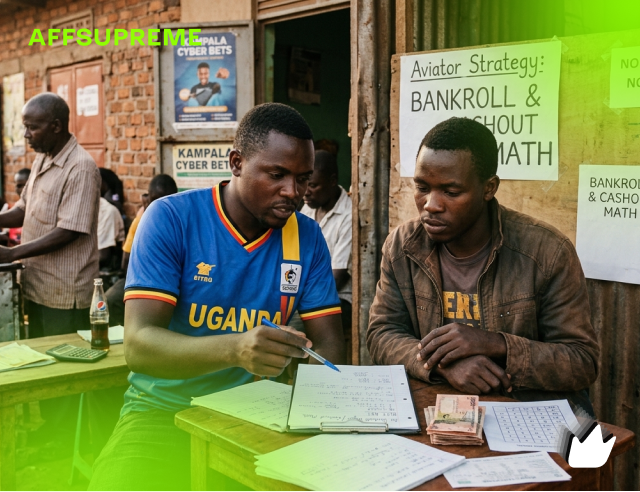
Aviator Strategy: Bankroll and Cash-Out Math (2026 Guide for African Players)
Every Aviator strategy comes down to two numbers: how much you stake per round and where you cash out. This guide works through the maths of both. It shows what each cash-out target really pays at Aviator’s listed 97% RTP, how long losing streaks get, how bankroll size changes your chances of lasting a session, and what happens to popular systems such as two bets and Martingale when you run the numbers.
The short version is uncomfortable but useful: no Aviator strategy beats the house edge. What a strategy can do is decide how bumpy the ride is and how fast your budget goes. We checked every fact in November 2026, and we ran the calculations and simulations ourselves using the standard crash-game model, which we explain below. We made no funded tests ourselves.
🔞 18+ (Uganda 25+)✈️ Spribe Aviator🧮 Maths checked in code📅 Updated 14 Nov 2026
AS
AffSupreme Editorial Team Updated November 14, 2026 · PokerListings; DeucesCracked; Malta Football; SlotCatalog; Paybillke; TechTrends KE; Bonuscode; LSLGA, GCG, GBT and NLGRB registers; AfricaSoccer; ChampsBase; Soccernet
Advertising disclosure: AffSupreme may earn a commission when you sign up through links on this page. This doesn’t change our analysis. We only link to casinos whose licence we could confirm in that country. We don’t link to any operator in Kenya until the GRA publishes its register, and we don’t recommend online casino games in South Africa, where they’re prohibited. Aviator is a game of chance, and this isn’t financial advice.
📌 Key takeaways
Every target loses about 3% on average: at a 97% RTP, cashing out at 1.2x, 2x or 10x all return roughly 97 for every 100 staked over time.
Targets change the ride, not the result: low targets win often and lose rarely but heavily relative to wins; high targets lose often and win big occasionally.
A 2x target lands about 48.5% of the time in the standard model, just below the 50% needed to break even.
Losing streaks are longer than they feel: at a 2x target, there’s about a 70% chance of at least eight losses in a row somewhere in 500 rounds.
Stake size decides survival: in our simulations, flat stakes of 1% of a bankroll almost never went bust in 500 rounds at 2x; stakes of 5% went bust about 61% of the time.
Martingale fails: doubling after losses from a 1% base went bust in about 89% of our 500-round simulations.
Speed is the real cost: at 60 rounds an hour, a ₦100 stake means ₦6,000 wagered and about ₦180 expected loss each hour.
🎯 Aviator cash-out targets at a glance
Target
Hit rate (model)
Break-even rate
Return per 100 staked
Ride
1.2x
80.8%
83.3%
97
Smooth, rare losses
1.5x
64.7%
66.7%
97
Steady
2x
48.5%
50%
97
Coin-flip swings
5x
19.4%
20%
97
Long dry spells
10x
9.7%
10%
97
Very streaky
Model: chance of reaching a target is 0.97 divided by the target. It’s an illustration based on the listed 97% RTP; Spribe doesn’t publish a per-target breakdown.
⚡ The short answer: what an Aviator strategy can and can’t do
Aviator, made by Spribe, has a listed RTP of 97%, according to SlotCatalog and PokerListings. That means the game returns about 97 of every 100 units staked over the long run, and keeps about 3. PokerListings puts it plainly: “No manual timing, betting system, or pattern changes those baseline odds. Adjustments only alter session variance.” DeucesCracked makes the same point: “The critical point is that this 3% applies regardless of when you cash out.”
Malta Football’s July 2026 guide, titled “The only Aviator strategy that actually holds up”, answers its own question in the first line: “There isn’t one, and anyone telling you otherwise is selling something.” It also notes that the 97% figure comes from review sites and isn’t confirmed by Spribe: “Treat it as the industry’s best guess, not gospel.”
So what’s left for a strategy to do? Three things, and they matter:
Choose your variance: how often you win, how big the swings are and how long the losing runs last.
Control your spend: how much you stake per round, how many rounds you play and when you stop.
Avoid mistakes that make things worse: lag, chasing losses, progressive systems and paid “signals”.
The rest of this guide puts numbers on each of those.
🧮 How Aviator crash points are distributed
Each Aviator round’s crash point is fixed before take-off by a provably fair system. SlotCatalog says it combines the operator’s server seed with seeds from the first three bettors, and publishes a hash before the round. Rounds are independent: Malta Football notes that “Crash points are generated independently each round by design.”
To do any maths, you need a model of how often the plane reaches each multiplier. Spribe doesn’t publish one. The standard model for crash games with a fixed RTP is simple:
Chance the plane reaches multiplier x = RTP ÷ x = 0.97 ÷ x So 2x is reached about 48.5% of the time, 10x about 9.7% and 100x about 0.97%.
This model has a neat property: whatever target you pick, the chance of reaching it times the payout always equals 0.97. That’s exactly what “the 3% applies regardless of when you cash out” means.
Does it match what’s reported? DeucesCracked’s September 2026 crash-game guide gives approximate frequencies without a formula: about half of rounds crash below 2x, about one in ten reach 10x or more, and rounds above 100x occur roughly once in 100. The model gives 51.5% below 2x, 9.7% at 10x or more and 0.97% at 100x or more. They line up.
The model also explains where the edge comes from. PokerListings says the edge comes mainly from rounds that crash instantly at 1.00x. In the model, the chance of reaching anything above 1x is 97%, which means about 3% of rounds end at 1.00x, before any cash-out is possible. DeucesCracked describes instant crashes only as “a small percentage of rounds”, without a figure, so treat 3% as the model’s figure rather than a published one.
⚠️ An illustration, not a guarantee. All our tables use this model with a 97% RTP. Real results over a few hundred rounds will vary widely, and operators can set their own limits. The model is useful because it shows the shape of the risk, not because it predicts any round.
📊 Every cash-out target, in numbers
Here’s the full picture for common targets. “Break-even rate” is how often you’d need to win to come out level. In every row, the hit rate falls just short of it.
Target
Hit rate
Loss rate
Break-even rate
Swing per round (SD)
1.1x
88.2%
11.8%
90.9%
0.36 stakes
1.2x
80.8%
19.2%
83.3%
0.47 stakes
1.3x
74.6%
25.4%
76.9%
0.57 stakes
1.5x
64.7%
35.3%
66.7%
0.72 stakes
2x
48.5%
51.5%
50%
1.0 stake
3x
32.3%
67.7%
33.3%
1.4 stakes
5x
19.4%
80.6%
20%
2.0 stakes
10x
9.7%
90.3%
10%
3.0 stakes
20x
4.9%
95.2%
5%
4.3 stakes
50x
1.9%
98.1%
2%
6.9 stakes
100x
1.0%
99.0%
1%
9.8 stakes
“Swing per round” is the standard deviation: a measure of how far a single round’s result typically lands from the average. At 1.2x, a round usually moves your balance by less than half a stake. At 10x it’s three stakes, and at 100x nearly ten. Same average, very different experience.
Notice how small the gap between hit rate and break-even rate looks: 2.5 percentage points at 1.2x, 1.5 at 2x. That’s why low targets “feel” profitable over an evening. The gap only shows up clearly over hundreds of rounds, which in Aviator doesn’t take long.
💸 Expected loss: what each session costs on average
Because every target returns about 97%, your expected loss depends only on how much you stake in total, not on where you cash out:
Expected loss ≈ 3% × total amount staked
PokerListings gives a worked example: $10 a round for 100 rounds is $1,000 wagered and an expected loss of about $30, “with real results varying widely”. The total staked grows quickly because rounds are fast. PokerListings says rounds are frequently under 30 seconds, and DeucesCracked puts the pace at 60 or more rounds an hour. Here’s what that means at a few stakes, one bet per round:
Stake per round
Staked in 60 rounds
Expected loss per hour
With two bets per round
₦50
₦3,000
₦90
₦180
₦100
₦6,000
₦180
₦360
₦200
₦12,000
₦360
₦720
GHS 1
GHS 60
GHS 1.80
GHS 3.60
TZS 1,000
TZS 60,000
TZS 1,800
TZS 3,600
Those are averages before tax. Your actual hour might end well up or well down, but the average is what the game collects from all players over time. Paybillke sums it up: “The speed, not the odds, is what does the damage.” Research cited by Malta Football (Harris and Griffiths, 2018, Journal of Gambling Studies) also linked higher event frequency to increased problem-gambling risk.
The practical lesson: the biggest lever you control isn’t the target. It’s the number of rounds you play and the stake you put on each.
📉 How long losing streaks really get
Most bankrolls don’t die from the house edge alone. They die in a losing streak that was longer than the player expected. DeucesCracked notes that streaks of ten or more rounds below 2x “occur regularly”. We calculated the chance of hitting at least one losing run of a given length within 100 and 500 rounds, using the model above:
Target
Losing run of at least…
Chance in 100 rounds
Chance in 500 rounds
1.5x
5 in a row
29.6%
83.5%
1.5x
8 in a row
1.5%
7.5%
2x
5 in a row
84.9%
Almost certain
2x
8 in a row
20.6%
70.2%
2x
10 in a row
5.7%
27.0%
5x
20 in a row
20.7%
73.6%
5x
30 in a row
2.2%
13.4%
10x
20 in a row
79.4%
Almost certain
10x
30 in a row
34.0%
92.2%
10x
40 in a row
11.4%
56.2%
At 60 rounds an hour, 500 rounds is a little over eight hours of play, or a few evenings. Read the table this way:
At 2x, five losses in a row is routine, and eight in a row is more likely than not over 500 rounds.
At 10x, going 30 rounds without a hit is more likely than not within 500 rounds. If you’re hunting 10x with a stake of 5% of your bankroll, 20 straight losses wipe out your entire bankroll.
At 1.5x, long streaks are rarer, but each loss costs two wins to recover, so short streaks still hurt.
The Bonuscode help centre says early-crash streaks are normal in random games and don’t predict future rounds. A streak doesn’t mean the plane is “due”. It means your bankroll needs to be big enough relative to your stake to survive it.
🏦 Bankroll sizing: the 1–2% rule, tested
PokerListings recommends keeping each round’s stake to 1–2% of your total funds and calls this “the primary defense” against drawdown during runs of low-multiplier crashes. With a $1,000 bankroll, that’s $10 to $20 a round. To see what that rule does in practice, we simulated 20,000 sessions of 500 rounds each, starting with 100 units and staking a fixed amount every round (1, 2 or 5 units). “Bust” means the balance fell below one stake.
Stake (share of bankroll)
Target
Went bust
Lost half or more
Finished ahead
Median finish (of 100)
1%
1.5x
0%
2.1%
17.2%
84.5
1%
2x
0%
6.1%
23.9%
86
1%
10x
17.1%
34.6%
37.1%
80
2%
1.5x
2.5%
25.8%
16.9%
69
2%
2x
9.5%
32.5%
23.9%
72
2%
10x
52.9%
57.4%
32.0%
0
5%
1.5x
53.6%
64.7%
16.7%
2.5
5%
2x
60.8%
67.1%
21.8%
0
5%
10x
81.7%
82.6%
16.3%
0
What the simulation shows:
Stake size matters far more than target. At 1%, almost nobody went bust at 1.5x or 2x. At 5%, most did, whatever the target.
Finishing ahead is the minority outcome at every setting, between about one in six and one in three. 500 rounds is enough for the 3% edge to show.
High targets need small stakes. At 10x, even 2% stakes went bust in more than half of sessions, while the few who finished ahead finished well ahead. That’s the lottery-like shape of high targets.
Low targets finish ahead less often than 2x or 10x, because they rarely produce a big enough run of luck to beat the edge, but they rarely blow up.
A practical rule: decide your session bankroll first, then set your stake at 1% of it (or less for targets above 3x). If the smallest stake your casino allows is more than 1% of what you can afford to lose, the session is too expensive for your budget.
🛑 Stop-loss, win goals and time limits
Limits don’t change the 3% edge, but they change how sessions end. Malta Football advises setting a loss limit and a time limit before each session and treating both as non-negotiable. PokerListings recommends deposit caps and session timers before betting. Here’s how each limit works mathematically:
🔻 Stop-loss
Stop when you’ve lost a set amount, such as 30% to 50% of the session bankroll. It caps your worst night, and since expected loss is 3% of total staked, it also caps how much you can stake.
🎯 Win goal
Stop when you’re up a set amount. You’ll hit small win goals often, which feels good, but it doesn’t change your average result. It mainly stops you giving a lucky run back.
⏰ Time limit
The most powerful limit, because it caps the number of rounds directly. At 60 rounds an hour, 30 minutes is about 30 rounds.
🔢 Round limit
If you use autoplay, set a number of rounds and stop conditions. Autoplay runs up to 100 rounds, according to crash-games.net.
A good session plan has all four, written down before you open the game. Paybillke’s advice is the simplest version: decide a loss ceiling before you open the game. It says the only lever with real effect is how much you’re willing to lose before starting.
🧭 Popular Aviator strategies, run through the maths
Here are the strategies you’ll see in guides and forums, with what the numbers say about each. Malta Football groups the main approaches into conservative auto cash-out (1.2x to 1.5x, low variance), mid-range manual (2x to 3x, moderate variance) and split bets (one low, one high). PokerListings describes three risk profiles: cautious, balanced and aggressive. None changes the 97% return; each changes the shape of your results.
1. The low-multiplier strategy (1.1x to 1.5x)
How it works: set auto cash-out at a low target and collect small, frequent wins. PokerListings’ cautious profile uses 1.2x to 1.5x with stakes capped at 1% of bankroll.
The maths: at 1.2x, you win about four rounds in five, but each win pays only 0.2 of your stake while each loss costs a full stake. One loss wipes out five wins. TechTrends KE describes low targets of 1.3x to 1.5x as giving “small amounts often with shallow swings”. The Bonuscode help centre gives a worked example: a bankroll of 40 units at a 1.4x target needs about five wins in every seven rounds just to break even.
Verdict: the smoothest ride and the lowest chance of busting, but you’ll rarely finish well ahead. Good for making a budget last, not for growing it.
2. The 2x strategy
How it works: cash out at 2x every round, doubling your stake when you win. PokerListings’ balanced profile uses a target near 2x with 1–2% stakes.
The maths: it’s close to a coin flip that’s slightly against you: 48.5% win, 51.5% lose. Swings are moderate, about one stake per round. Over 500 rounds at 1% stakes, about one session in four finished ahead in our simulation.
Verdict: easy to understand and track. Watch out for losing runs: eight in a row is more likely than not over 500 rounds.
3. High-multiplier hunting (5x and above)
How it works: aim for 5x, 10x or more and accept many losses for an occasional big win. PokerListings’ aggressive profile targets above 5x, with stakes still under 2% of funds.
The maths: at 10x you lose about nine rounds in ten, and 30-round dry spells are more likely than not over 500 rounds. Swings are around three stakes per round. In our simulation, 10x at 2% stakes went bust in more than half of sessions.
Verdict: only works with very small stakes relative to your bankroll. It’s closer to buying lottery tickets than to a “strategy”.
4. Two bets (dual bet): one safe, one high
How it works: Aviator lets you place two bets in the same round. PokerListings describes splitting your stake: one half with auto cash-out at about 2x to recover the total stake, the other running towards a higher target. Malta Football gives an example of 1.3x on one bet and a manual higher target on the other.
The maths: take a total stake split into two halves, one cashing out at 2x and one at 10x. Using the model:
What happens
Chance
Result (total stake = 1)
Crash below 2x
51.5%
Lose 1
Crash between 2x and 10x
38.8%
Break even
Reach 10x
9.7%
Win 5
Average: (9.7% × 5) − (51.5% × 1) = −0.03, the same 3% loss. DeucesCracked calls the dual bet “a variance tool, not an edge”. Note that the “safe” half doesn’t make the round safe: more than half the time you still lose everything, because the plane crashes before 2x. Two bets also double how much you stake per round, so they double your expected loss per hour unless you halve each stake.
Verdict: a reasonable way to mix steady and big results, as long as you count both bets as one stake.
5. Martingale: doubling after every loss
How it works: bet at 2x; after each loss, double the stake, so one win recovers all losses plus the first stake.
The maths: the stakes grow fast: 1, 2, 4, 8, 16, 32, 64. After six straight losses you’ve lost 63 units and need to stake 64 more. With a bankroll of 100 units, six losses in a row at 2x (a 1.9% chance each time a sequence starts) means you can’t make the next bet. In our simulation of 20,000 sessions starting with a 1-unit base and 100 units, 88.8% went bust within 500 rounds and only 16.5% finished ahead. Even over 200 rounds, 69.3% went bust.
The table limit makes it worse. Aviator’s stakes typically run from 0.10 to 100 in the casino’s currency unit, according to PokerListings and Casino Guru. Starting at 0.10, the tenth bet in a doubling sequence would be 51.20 and the eleventh would be over the 100 maximum, so the system breaks after ten losses even with unlimited money. DeucesCracked says finite bankrolls and table limits “eventually break the sequence”, and PokerListings warns that doubling stakes after early crashes speeds up depletion.
Verdict: lots of small wins, then a catastrophic loss. Avoid it.
6. Reverse Martingale, D’Alembert and Fibonacci
These systems change stakes after wins or losses in different patterns: raising after wins (reverse Martingale), adding one unit after a loss and removing one after a win (D’Alembert), or following the Fibonacci sequence after losses. The maths is the same for all of them: since every round is independent and returns 97% on average, the expected loss is still 3% of the total staked. Systems that raise stakes after losses (D’Alembert, Fibonacci) increase the total staked during losing runs, so they push you towards bigger losses more slowly than Martingale, but in the same direction. Systems that raise stakes after wins simply bet more of your winnings at the same 3% edge.
Verdict: no staking pattern creates an edge. Flat stakes are the easiest to control.
7. Reading the history and “timing” rounds
The round history strip invites pattern-spotting. Paybillke warns this is the gambler’s fallacy: rounds are independent, so the history doesn’t predict the next round. DeucesCracked says: “Each round is independent. A run of low crashes does not make a high one more likely.” The Bonuscode help centre adds that the crash point doesn’t depend on how many people are playing or how much they stake.
Verdict: ignore the history strip for betting decisions.
📐 What the Kelly criterion says about Aviator
The Kelly criterion is a well-known formula for sizing bets when you have an edge. It says the ideal share of your bankroll to stake grows with your advantage. When the expected value is negative, as it is at every Aviator target, the Kelly answer is zero: no stake size maximises long-term growth, because there’s no growth to maximise.
That doesn’t mean you can’t play. It means bankroll maths for Aviator isn’t about growing money. It’s about budgeting entertainment: choosing a stake small enough that the money lasts as long as you want to play, and a stop point that limits the cost. As TechTrends KE puts it, early, disciplined cash-outs are a way to control how you spend an entertainment budget, not a way to grow it.
📝 Build your own Aviator plan: a worked example
Here’s how to put the numbers together. Say your entertainment budget for the week is ₦10,000 and you’re willing to lose all of it.
Set the session bankroll. Split the week into two sessions of ₦5,000. Whatever happens in session one, session two keeps its ₦5,000.
Choose the stake. 1% of ₦5,000 is ₦50. Check your casino’s minimum stake: Soccernet lists Betano Nigeria’s crash games from ₦30, so ₦50 fits.
Choose the target. For a steady session, 1.5x or 2x. At 2x, expect roughly half your rounds to win.
Set auto cash-out at your target, so lag or nerves don’t decide for you.
Set limits. Stop-loss at ₦2,500 (half the session bankroll), a win goal of ₦2,500, and a 45-minute timer.
Know the cost. About 45 rounds at ₦50 is ₦2,250 staked, so the average cost is about ₦68 before tax. Your actual result will vary.
Stop when any limit is hit, and don’t raise the stake to win back losses.
The same plan works in any currency: replace the bankroll and use 1% of it as your stake.
🧾 How tax changes the maths in each country
The 97% figure is before tax. Where winnings are taxed, the return you actually receive is lower, and taxes on winnings hit high targets harder than low ones, because more of each payout is profit. The table below assumes a tax is taken only from the profit part of a winning cash-out (not the stake). It’s an illustration; check how your casino applies it.
Tax on winnings
1.2x
1.5x
2x
5x
10x
None
97%
97%
97%
97%
97%
5%
96.2%
95.4%
94.6%
93.1%
92.6%
15%
94.6%
92.2%
89.7%
85.4%
83.9%
20%
93.8%
90.5%
87.3%
81.5%
79.5%
Figures are the return per 100 staked. At a 20% tax, a 10x target returns about 79.5, against 93.8 at 1.2x. Where winnings are taxed, lower targets lose less on average.
What our sources say about each country:
Nigeria: Lagos applies a 5% withholding tax on gaming payouts, Nairametrics reported in February 2026. ChampsBase reported casino winnings taxed at 20% at SportyBet. The two sources conflict, so check the deduction shown in your casino’s terms.
Kenya: Paybillke lists 5% excise on deposits, 20% withholding on winnings and 5% withholding on money paid out. There’s no tax on the stake itself. With all three, Kenyan players face the steepest drag in this guide.
Ghana: the 10% withholding tax on gambling winnings was repealed from 2 April 2025, next.io reported.
Uganda: a 15% withholding tax on winnings applies from 1 July 2026, according to the sources in our Uganda research.
Tanzania: sources conflict between 12% (the Finance Act 2025, as described by 22Bet’s tax guide) and 15% from 1 July 2026 (iGaming Times). Both are stated; confirm with your casino.
Zambia: sources conflict on whether the 15% winnings tax still applies (FocusGN says it was maintained; Gambling Maps says winnings withholding ended on 1 January 2026).
🌍 Playing Aviator legally: country notes
Strategy maths assumes the game is the genuine Spribe version and that you’ll be paid. That’s only guaranteed at a casino licensed in your country.
🇳🇬 Nigeria: online casinos are licensed by the states; Lagos’s LSLGA publishes its register and named 44 unlicensed operators, including Stake and bet365, in September 2026.
🇬🇭 Ghana: the Gaming Commission of Ghana’s register lists online casino entries separately.
🇰🇪 Kenya: the former BCLB ordered audits of Aviator and crash games and banned standalone Aviator apps, AllAfrica reported in 2025. The GRA has listed 11 licensed operators, including OdiBets, SportyBet, SportPesa and Betika, but hasn’t published a register, so we don’t link to Kenyan operators.
🇺🇬 Uganda: the NLGRB licenses casinos; the minimum age is 25.
🇹🇿 Tanzania: the Gaming Board licenses online casinos separately from sports betting; look for an OCL licence.
🇿🇲 Zambia: there’s no online casino licence class or public register, so we don’t recommend Aviator sites there.
🇿🇦 South Africa: online casino games, including Aviator, are prohibited under the National Gambling Act.
🏆 Licensed casinos to play Aviator with a plan
These licensed casinos run Aviator and suit a small-stake, 1%-of-bankroll approach. Minimum stakes vary by casino and currency, so check them in the game before setting your plan. Full scores are in our Aviator auto cash-out guide.
SportyBet Nigeria: auto cash-out and two bets confirmed
🛡️ Licence: LSLGA, to 4 Jan 2027
✈️ Aviator: auto bet, auto cash-out, dual bet (AfricaSoccer)
⚡ Load: 1.8 s (ChampsBase)
💸 Withdrawals: ₦1 minimum (ChampsBase)
AfricaSoccer’s July 2026 guide confirms auto bet, auto cash-out and dual bets at SportyBet Nigeria. That’s everything a bankroll plan needs: a preset target, a fixed stake and the option to split it. ChampsBase measured a 1.8-second load and saw one two-second freeze, which is a good reason to use auto cash-out. ChampsBase also reported casino winnings taxed at 20%, so factor that into your targets.
Soccernet lists Betano’s crash games from ₦30 to ₦30,000 per stake. A ₦30 minimum means a 1% stake works with a session bankroll of ₦3,000, which makes Betano a good fit for small-budget plans.
ChampsBase played 12 Aviator rounds at Bet9ja without lag, with load times of 4 to 7 seconds on 5G. Stable rounds matter if you cash out manually; with auto cash-out set, your target is applied whatever your connection does.
Betway Ghana: full Aviator toolset, no winnings tax
🛡️ Licence: GCG online casino entry, 2026
✈️ Aviator: dual bet, auto bet, auto cash-out (AfricaSoccer)
AfricaSoccer confirms dual bets, auto bet and auto cash-out in Betway Ghana’s Aviator, with stakes in cedis. With Ghana’s winnings tax repealed, the maths in this guide applies without the tax drag you’d face in Kenya or Uganda.
BetRank GH lists GHS 1 deposits and 25 Aviator free bets of GHS 1 each at Betika Ghana. Free bets let you try your plan without staking your own money, though the maths of each round is the same.
💰 Small amounts: Aviator from UGX 1 in Uganda (TopBetsUG); deposits from TZS 100 in Tanzania
🔞 Age: 18+ in Tanzania, 25+ in Uganda
🏁 Cap: UGX 900m per flight in Uganda (Pulse UG)
betPawa holds a Tanzanian online casino licence and a Ugandan casino licence, TopBetsUG lists a UGX 1 minimum Aviator stake in Uganda, and Tanzanian deposits start from TZS 100. Low minimums make it easy to keep stakes at 1% of even a small bankroll. Remember Uganda’s 15% winnings tax when choosing targets.
Auto cash-out doesn’t change the odds; Paybillke calls it a discipline tool. But it does fix two real problems that cost players money beyond the 3% edge:
Lag: PokerListings warns that poor connectivity can stop a manual cash-out reaching the server in time. Malta Football gives an example: a manual cash-out aimed at 2.40x missed because the round crashed at 2.20x during lag. ChampsBase saw a two-second freeze during one SportyBet round.
Nerves: TechTrends KE says auto cash-out helps by removing in-the-moment emotional decisions. Holding on “just a bit longer” turns a 2x plan into an unplanned high-target bet.
Disconnects aren’t a disaster either way: the Bonuscode help centre says most platforms settle a round as recorded on the server, and reconnecting shows the result but doesn’t change it. With auto cash-out set, the server applies your target even if your screen freezes.
How to set it: in the bet panel, switch to Auto, turn on auto cash-out and enter your target before the round. If you use autoplay, set the number of rounds and stop conditions every time. crash-games.net says autoplay runs up to 100 rounds with stop conditions.
🚫 Common bankroll mistakes
Staking too much per round. At 5% stakes, most of our simulated sessions went bust within 500 rounds.
Chasing losses. PokerListings calls doubling after early crashes “a frequent misstep”; it speeds up depletion.
Counting two bets as two small bets. They’re one stake split in two, and they double your hourly cost if you don’t halve them.
Moving the target mid-session. Raising your target after a loss turns a low-variance plan into a high-variance one at the worst moment.
Ignoring tax. A 20% winnings tax turns a 97% game into about 87% at 2x.
Playing without a timer. At 60 or more rounds an hour, time is the biggest driver of what you stake.
Trusting predictors or signals. PokerListings says so-called “Aviator predictor” services are scams; no app can know a crash point.
Treating a demo run as proof. Paybillke warns demo streaks predict nothing about real rounds, and demo play misleads about risk because losses cost nothing.
❓ Strategy myths, checked against the maths
“Low targets are safe”
They’re low-variance, not safe. At 1.2x one loss cancels five wins, and the return is still 97%.
“The plane is due a big one”
Rounds are independent. A run of low crashes doesn’t raise the chance of a high one.
“Bet when fewer people are playing”
The crash point doesn’t depend on player numbers or stakes, Bonuscode says.
“One casino’s Aviator pays better”
Paybillke notes Aviator is the same Spribe game at every operator, with the same 97% RTP.
“Two bets cover the risk”
In our example, you still lose your whole stake 51.5% of the time.
“A system can beat 3%”
No staking pattern changes a negative expected value. The Kelly stake for a negative edge is zero.
✅ Checklist before you play Aviator
The casino is licensed in your country, and you’ve checked its register entry.
You’ve set a session bankroll you can afford to lose completely.
Your stake is about 1% of it, or less for targets above 3x.
Auto cash-out is on at a target you chose before the session.
You’ve set a stop-loss, a win goal and a timer.
You know the tax that applies to winnings in your country.
You’ve set a deposit limit in your account.
You’re not chasing losses or playing with money meant for essentials.
📖 Glossary
RTP (return to player): the share of stakes a game returns over the long run; Aviator’s listed RTP is 97%.
House edge: what the game keeps over time, here about 3%.
Expected value (EV): the average result per round if you played forever; at every Aviator target it’s about −3% of the stake.
Variance / standard deviation: how far results swing around the average.
Hit rate: how often a cash-out target is reached.
Break-even rate: how often you’d need to win to come out level; 1 ÷ target.
Bankroll: the money set aside for a session or a period.
Unit: one stake, often set at 1% of the bankroll.
Stop-loss: the loss at which you end a session.
Martingale: doubling the stake after every loss.
Kelly criterion: a bet-sizing formula; for a negative edge it gives zero.
Instant crash: a round ending at 1.00x, before any cash-out is possible.
🔍 How we researched this guide
Game facts and strategy descriptions come from PokerListings, DeucesCracked (September 2026), Malta Football (July 2026), SlotCatalog, Casino Guru and crash-games.net, with Paybillke, TechTrends KE and the Bonuscode help centre on predictors, demo play and discipline. All probability tables, losing-streak figures, tax illustrations and bankroll simulations are our own calculations, using the model “chance of reaching x = 0.97 ÷ x”. The simulations ran 20,000 sessions of 500 rounds each. We checked the model against DeucesCracked’s reported frequencies. Licences come from the LSLGA, GCG, GBT and NLGRB registers, and casino details from AfricaSoccer, ChampsBase, Soccernet, BetRank GH, TopBetsUG and Pulse Uganda, as used in our earlier Aviator guides. Tax sources are Nairametrics, Paybillke, next.io, iGaming Times, 22Bet’s tax guide, FocusGN and Gambling Maps. We made no funded tests ourselves, and where sources disagree, we say so.
❓ Frequently asked questions
What is the best Aviator strategy?
There isn’t one that beats the game. The best you can do is pick a target that suits you, stake about 1% of your bankroll per round, use auto cash-out and set stop limits.
Can any Aviator strategy make a profit long term?
No. At a 97% RTP, every target returns about 97 for each 100 staked over time.
What is Aviator’s RTP?
97%, according to SlotCatalog and PokerListings. Malta Football notes Spribe hasn’t confirmed it publicly.
How often does Aviator reach 2x?
About 48.5% of rounds in the standard model, consistent with DeucesCracked’s estimate that about half of rounds crash below 2x.
How often does Aviator reach 10x?
About 9.7% of rounds in the model, or roughly one in ten, as DeucesCracked reports.
How often does Aviator reach 100x?
About 1% of rounds in the model; DeucesCracked says roughly once in 100.
How often does the plane crash instantly at 1.00x?
The model implies about 3% of rounds. Spribe doesn’t publish a figure, and DeucesCracked calls it a small percentage.
What’s the safest cash-out target?
Low targets such as 1.2x to 1.5x have the smallest swings and lowest bust risk, but they still lose about 3% on average.
Is 1.2x a good strategy?
It wins about 80.8% of rounds but needs 83.3% to break even. One loss cancels about five wins.
Is 2x better than 1.5x?
Neither is better on average. 2x swings more, and in our simulation it finished ahead more often but went bust more often at larger stakes.
How much should I bet per round?
PokerListings recommends 1–2% of your bankroll. In our simulations, 1% stakes almost never went bust in 500 rounds at 1.5x or 2x.
How big should my Aviator bankroll be?
At least 100 times your stake for low targets, and more for high targets. If 1% of what you can afford to lose is below your casino’s minimum stake, the session is too expensive.
How long can a losing streak last?
At 2x, about a 70% chance of eight or more losses in a row within 500 rounds. At 10x, 30-round dry spells are more likely than not over 500 rounds.
Does the Martingale strategy work in Aviator?
No. In our simulation, 88.8% of Martingale sessions from a 1% base went bust within 500 rounds.
Why does Martingale fail even with a big bankroll?
Table limits. Starting at 0.10 with a 100 maximum, the eleventh doubled bet exceeds the limit.
Does the two-bet strategy reduce risk?
It changes the shape of results, not the average. With halves at 2x and 10x, you still lose your whole stake 51.5% of the time.
Do two bets cost more?
Yes. Two bets per round double the amount staked, and so the expected loss, unless you halve each stake.
Do D’Alembert or Fibonacci systems work?
No. Rounds are independent, so the expected loss stays 3% of the total staked, whatever the pattern.
What does the Kelly criterion say about Aviator?
With a negative expected value, the Kelly stake is zero. Bankroll maths here is about budgeting, not growth.
How much does an hour of Aviator cost on average?
About 3% of what you stake. At 60 rounds of ₦100, that’s ₦6,000 staked and about ₦180 expected loss, before tax.
How many rounds are there per hour?
DeucesCracked says 60 or more, and PokerListings says rounds are frequently under 30 seconds.
Should I use a stop-loss?
Yes. Malta Football advises setting loss and time limits before every session and treating them as non-negotiable.
Does a win goal improve my results?
Not on average, but it helps you stop before giving back a lucky run.
Does auto cash-out improve the odds?
No, but it removes lag and emotional decisions that can cost you more than the edge.
What happens if my connection drops?
Most platforms settle the round as recorded on the server, Bonuscode says. With auto cash-out set, your target still applies.
Does the round history help predict the next crash?
No. Rounds are independent, and reading the history is the gambler’s fallacy.
Do Aviator predictor apps or signals work?
No. PokerListings calls them scams, and no app can know a crash point that’s fixed and hashed before take-off.
How does tax affect my strategy?
Taxes on winnings lower your return more at high targets. At 20%, 2x returns about 87.3% and 10x about 79.5%, in our illustration.
What tax applies in Kenya?
Paybillke lists 5% excise on deposits, 20% withholding on winnings and 5% withholding on payouts.
Is there tax on Aviator winnings in Ghana?
The 10% withholding tax on gambling winnings was repealed from 2 April 2025, next.io reported.
What’s the minimum Aviator stake?
It varies by casino and currency. PokerListings and Casino Guru put typical stakes at 0.10 to 100; Soccernet lists Betano Nigeria’s crash games from ₦30.
Is the demo good for testing a strategy?
It’s good for learning the controls, but Paybillke warns demo streaks predict nothing and losses that cost nothing distort your sense of risk.
Where can I play Aviator legally?
At casinos licensed in your country: for example SportyBet, Betano or Bet9ja in Nigeria, Betway or Betika in Ghana, and betPawa in Tanzania and Uganda.
Is Aviator legal in Kenya?
Aviator must be offered inside licensed platforms; standalone Aviator apps were banned. We don’t link to Kenyan operators until the GRA publishes its register.
Aviator’s speed is what makes a small edge expensive. If you notice yourself raising stakes to win back losses, moving your target after a bad run or playing past your timer, stop. Warning signs of a problem include chasing losses, borrowing to play, using money meant for essentials and hiding gambling from family.
Nigeria: SafePlay self-exclusion; Gamble Alert support service.
Ghana: Mental Health Authority, 0800 678 678.
Kenya: GRA helpline, 0800 723 770.
Tanzania: GBT, 0800 110 051; Afya Call Center, 199.
Uganda: NLGRB self-exclusion.
Zambia: Lifeline Zambia, 933.
🔞 Adults only: 18+ (Uganda 25+).
🏁 Final verdict: Aviator strategy, bankroll and cash-out math
The maths of Aviator is simple and firm: at a 97% RTP, every cash-out target loses about 3% of what you stake over time, and no system changes that. What your strategy controls is the ride and the cost. Low targets give smooth sessions; high targets give long droughts and occasional big wins; two bets mix the two. Stake size matters most: around 1% of your session bankroll keeps bust risk low, while 5% stakes went bust in most of our simulations, and Martingale failed almost every time. Set auto cash-out, a stop-loss, a win goal and a timer, account for tax in your country, and play only at a casino licensed where you live.