


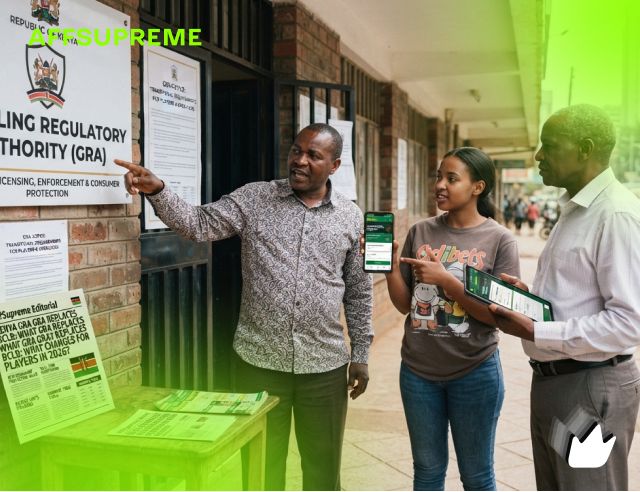
Kenya’s GRA Replaces the BCLB: What Changes for Players in 2026
For almost six decades, Kenyan betting was policed by the Betting Control and Licensing Board under a 1966 law written long before smartphones and M-Pesa. That era is over. The Gambling Control Act, 2025 created the Gambling Regulatory Authority of Kenya (GRA), which formally took over from the BCLB on 28 February 2026, and five sets of regulations came into force on 30 June 2026.
For punters, the changes are practical, not just legal: a new licence list, new rules on which paybills can take your money, a reworked tax system, stricter ID checks, a minimum stake, tougher limits on advertising, a self-exclusion that can’t be cut short, and a new tribunal for disputes. This guide explains what has actually changed, what is still being fought over in court, and what you should do now. Every fact below was checked against a named source in November 2026; where sources disagree, we say so.
This is a news and explainer page. It contains no betting links or offers. It isn’t legal or tax advice; for your own situation, check the GRA and the Kenya Revenue Authority directly.
📌 Key takeaways
- New regulator: the GRA formally took over from the BCLB on 28 February 2026, under the Gambling Control Act, 2025.
- New licence list: in a letter to Safaricom dated 2 November 2026, the GRA named 11 operators licensed for 2026/27, including SportPesa, Betika, OdiBets and SportyBet, and said the list will be updated as more licences are issued.
- Paybills: the GRA asked Safaricom to act against payments for unlicensed operators, so balances on sites not yet relicensed are at risk of disruption.
- Taxes: 5% excise on money you deposit to bet, 5% withholding tax on payouts to your account, and, since 1 July 2026, 20% withholding tax on winnings from lotteries and prize competitions.
- ID and age: 18+ only, with age verification by National ID or passport.
- Minimum online stake: Ksh20 under the Act.
- Self-exclusion: at least six months and can’t be shortened; families can apply to have a relative excluded.
- Still in court: operators’ challenge to the new licence fees (Judicial Review E251 of 2026) hasn’t been decided.
🔁 BCLB vs GRA at a glance
| Area | Under the BCLB (old law) | Under the GRA (new law) |
|---|---|---|
| Law | Betting, Lotteries and Gaming Act, Cap 131 (1966) | Gambling Control Act, 2025 plus five 2026 regulations |
| Regulator | Betting Control and Licensing Board | Gambling Regulatory Authority of Kenya, a state corporation |
| Licence term | One year | 36 months, according to a Citizen Digital analysis |
| Bet tax | 15% excise on stakes until June 2025 | 5% excise on amounts deposited to bet |
| Winnings tax | 20% on winnings until June 2025 | 5% on payouts to your account; 20% on lottery and prize-competition winnings |
| Minimum online stake | Not set in the 1966 Act; the BCLB had proposed a minimum (Nation) | Ksh20 |
| Self-exclusion | Operator by operator | Minimum six months, can’t be shortened; family applications allowed |
| Advertising | BCLB guidelines (May 2025) | Rules in law: approval by both the GRA and the KFCB, no celebrities or influencers, no TV or radio ads from 6am to 10pm except during live sport |
| Disputes | No specialist gambling tribunal | Gambling Appeals Tribunal |
Sources: Bowmans; CM Advocates; Citizen Digital; KRA; EY; Business Daily; The Star; FocusGN. Each point is explained, with its source, in the sections below.
🏛️ Why Kenya replaced the BCLB
The Gambling Control Act, 2025 replaces the Betting, Lotteries and Gaming Act, Cap 131, which had stood largely unchanged since 1966. The old law predated online betting, crash games and mobile money. GRA Director General Peter Karimi has acknowledged that the previous framework was inadequate for modern challenges such as online betting and consumer protection, The Standard reported.
The scale of the market explains the urgency. Kenya Revenue Authority data shows that Kenyans wagered a record Sh330.5 billion in the year to 30 June 2026, Business Daily reported. Gambling tax revenue rose 11% to Ksh28.45 billion by April 2026, according to GRA figures shared with the KRA (Sigma).
The new law also changes the regulator’s status. Under the Act, the BCLB is replaced by a Gambling Regulatory Authority set up as a state corporation, with greater operational and financial independence, according to an analysis in Citizen Digital. All of the BCLB’s functions, assets and obligations transfer to the GRA.
📅 Timeline: from the BCLB to the GRA
| Date | What happened |
|---|---|
| May 2025 | The BCLB issues strict advertising guidelines, including a ban on celebrities and influencers in gambling ads. |
| 27 June 2025 (Finance Act 2025) | Bet excise is cut from 15% of stakes to 5% of deposits, and the 20% tax on winnings is replaced by 5% on withdrawals, effective 1 July 2025. |
| 7 August 2025 | President Ruto signs the Gambling Control Act, 2025 (KBC; The Kenya Times). |
| August 2025 | The Act comes into force. Bowmans and Afriwise give 26 August 2025; Kenya Law’s record of Cap 131 shows it repealed on 20 August 2025 (see the conflicts note below). |
| 28 February 2026 | The GRA formally takes over regulatory responsibilities from the BCLB (FocusGN). |
| 31 March–1 April 2026 | Public consultations on the draft regulations held at KICC, Nairobi. |
| 25 April 2026 | The GRA forms a unit to tackle gambling addiction (The Star). |
| 23 June 2026 | The Finance Act, 2026 is signed. It reintroduces 20% withholding tax on lottery and prize-competition winnings and redefines “withdrawals”; most changes take effect from 1 July 2026. |
| 29–30 June 2026 | Five regulations are gazetted as Legal Notices 111–115 and come into force on 30 June 2026. |
| 20 July 2026 | The High Court freezes the Licensing Regulations in Judicial Review E251 of 2026. |
| 22 July 2026 | The GRA unveils a digital Gambling Management System for real-time monitoring. |
| 24–25 August 2026 | The court lets the GRA implement the Licensing Regulations and collect the new fees while the case continues. |
| 2 October 2026 | The expected judgment isn’t delivered; the case is set for mention on 12 October. |
| 2 November 2026 | The GRA writes to Safaricom naming 11 operators licensed for 2026/27. |
🔢 The transition in numbers
| Figure | What it means | Source |
|---|---|---|
| Sh330.5 billion | Amount Kenyans wagered in the year to 30 June 2026, a record | KRA data via Business Daily |
| Ksh28.45 billion | Gambling tax revenue by April 2026, up 11% year on year | GRA figures via Sigma |
| 187 | Rows in the GRA’s 2025/26 licensed-operators table | Footboom, read 9 Nov 2026 |
| 246 | Licence applications pending when the GRA asked the court to lift the fee freeze | African Gambit |
| 11 | Operators named as licensed for 2026/27 in the GRA’s 2 November letter | PaybillKE; iGamingToday |
| 58+ | Betting companies flagged by the BCLB in 2025 for illegally operating in Kenya’s internet domain | Business Daily |
| Ksh20 | Minimum online stake under the Act | Sigma; Kenyans.co.ke |
| KES 50 million | Maximum fine for unlicensed gambling operations, and for foreign-facing firms that fail to geo-block Kenyans | Bowmans; Business Daily |
| 30% | Minimum share of an operator that must be held by Kenyan citizens | The Kenya Times |
| 6 months | Minimum self-exclusion period, which can’t be shortened | Business Daily |
Two numbers show the shape of the transition: more than 180 operators held licences under the old table, but only 11 had been confirmed for the new period by early November, with hundreds of applications still pending. Expect the list to grow, and expect some familiar names to drop off it.
👥 Who runs the GRA
- Director General: Peter Karimi (The Standard; The Star). Peter Mbugi led the authority as acting Director General during the transition (Sigma).
- Chairman: Joseph Kirui Limo, a former MP appointed by President Ruto as non-executive chairman (Sigma; The Star).
- Website: gra.go.ke. The regulations were published there and in the Kenya Gazette (FocusGN; CM Advocates).
Karimi has said the authority is shifting its focus “from basic licensing to active market surveillance and consumer protection”, The Star reported.
📜 The five regulations, in plain English
The Act sets the principles; the regulations fill in the detail. All five came into force on 30 June 2026, Bowmans says:
Licensing Regulations
Set licensing requirements for casinos, bookmakers, lotteries, online gambling operators, equipment makers, software providers and key gambling employees (Sigma). The new fees are being challenged in court.
Conduct of Gambling Operations
Require real-time access for the GRA through a secure API, integration with the KRA, self-exclusion rules and data stored on servers in Kenya (Sigma; Bowmans).
Foreign-Based Operators
Cover Kenyan-licensed firms serving overseas markets: KES 100 million paid-up capital, a KES 200 million bond and mandatory geo-blocking of Kenyan residents (FocusGN; Business Daily).
Advertising
Require approval from both the GRA and the Kenya Film Classification Board, ban celebrities and influencers, and restrict broadcast times (Business Daily; The Star).
Gambling Appeals Tribunal
Set timelines, procedures and evidence rules for appeals against GRA decisions (Bowmans).
National Lottery
A separate Conduct of a National Lottery Regulations, 2026 was also gazetted, as Legal Notice 116 (Parliament of Kenya library).
✅ Change 1: a new licence list
This is the change that matters most day to day. A licence issued under the old law stayed valid until it expired, after which the holder had to apply to the GRA for a new one, CM Advocates explained. Licences now run for 36 months instead of one year, according to Citizen Digital’s analysis of the Act.
The 2026/27 list. In a letter to Safaricom dated 2 November 2026 (reference GRA 15/1 VOL.II (19)), the GRA named 11 operators that had met licensing requirements for the 2026/27 financial year (PaybillKE; iGamingToday):
| # | Trading name named by the GRA |
|---|---|
| 1 | SportPesa |
| 2 | Betika |
| 3 | OdiBets |
| 4 | Pepeta |
| 5 | Yowin |
| 6 | Finix Casino |
| 7 | Bongobongo |
| 8 | Gamemania |
| 9 | SportyBet |
| 10 | Wezabet |
| 11 | Betnare |
The GRA said the list may be updated as more licences are issued. PaybillKE noted that betPawa, Mozzart Bet, 1xBet and 22Bet weren’t on the 2 November letter. That doesn’t necessarily mean they won’t be licensed; when the letter was written, 246 licence applications had been pending, according to the GRA’s submission to the court reported by African Gambit.
The older table. The GRA’s “Licensed operators” page also carries a table for 2025/26, which had 187 rows when Footboom read it on 9 November 2026. Make sure you’re looking at the current period, not last year’s.
Why we don’t link to any operator here: licensing in Kenya is still changing week to week. Check the GRA’s own list on gra.go.ke before you deposit anywhere.
📱 Change 2: paybills and your M-Pesa balance
Most Kenyans deposit and withdraw through M-Pesa paybills, so the regulator’s control over payments affects you directly.
- The 2 November letter cites Section 28(1) of the Act, under which nobody may offer gambling without a licence, and asks Safaricom to proceed with enforcement (PaybillKE).
- Payment providers need approval: the 2026 conduct regulations require payment service providers to have regulatory approval to process or settle gambling payments (FocusGN).
- Earlier warnings: in September 2026, AGOK raised concerns about messages sent through Safaricom threatening to switch operators’ paybills on 24 September; the court said its status quo orders were meant to prevent such action (FocusGN).
- History: in 2019 the BCLB had 27 operators’ paybills shut and gave gamblers 48 hours to withdraw (The EastAfrican), and in April 2025 it ordered paybills of more than 50 illegal operators suspended (Capital FM).
What to do: if you hold a balance with an operator that isn’t on the current GRA list, consider withdrawing it rather than waiting. Keep screenshots of your balance and transaction history in case you need to make a claim later.
💸 Change 3: how your bets and winnings are taxed
Tax isn’t set by the GRA (the KRA collects it), but it changed alongside the new law, and it’s the change punters notice first.
| Tax | Rate | When it’s charged | Source |
|---|---|---|---|
| Excise duty | 5% | On the amount deposited for betting; the Finance Act 2026 changed the base from wallet deposits to deposits made for the purpose of betting | KRA; KPMG |
| Withholding tax on withdrawals | 5% | Since 1 July 2026, on money paid or disbursed to your account, not only when you cash out to M-Pesa | EY; Academy of Tax Law |
| Withholding tax on winnings | 20% | On payouts from a lottery or prize competition by a licensed operator | Finance Act 2026; EY; Afriwise |
The big change in 2025: before July 2025, a 15% excise applied to every stake and 20% to winnings. The Finance Act 2025 moved to 5% on deposits and 5% on withdrawals, a change that, Business Daily said, shifted the tax base from winnings to the amounts withdrawn.
The 2026 twist: the Finance Act 2026 redefined “withdrawals” as any amount “paid or disbursed to the player’s account”. Analysts say this moves the tax point to the moment a payout lands in your account and closes a loophole that let players defer tax by re-betting winnings before withdrawing (Academy of Tax Law).
Sources disagree on sports-bet winnings. EY, Afriwise and the KRA’s published definition say the reintroduced 20% applies to winnings from lotteries and prize competitions, with betting customers paying 5% on withdrawals. However, Business Daily wrote in September 2026 that punters pay “a further 20 percent withholding tax on each winning bet”, and PaybillKE also describes the 20% as applying on top of the 5%. Check your operator’s tax statement and the KRA.
Worked example (deposit tax only): you send Ksh1,000 to your betting account. At 5% excise, Ksh50 goes to tax. How the 5% is shown, whether deducted from your deposit or added on top, depends on the operator, so check its tax page.
🪪 Change 4: age checks and identity
- 18+ only: the new measures include mandatory age verification using a National Identity Card or passport, so that only people aged 18 and over can gamble (The Star).
- Registration: players must register accounts on licensed sites, and operators must require proof of age before registering a player (Sigma).
- Verified ID and ring-fenced funds: operators must register players with verified identification and keep player money in segregated accounts, separate from operational funds (CM Advocates).
- Stricter checks proposed: earlier proposals included biometric checks such as facial recognition or fingerprint for every new account (The Standard), and a BCLB plan for players to submit a selfie holding their national ID (Gambling Insider). Check your operator’s sign-up process for what it currently asks.
- Age 21 proposal: MPs proposed raising the legal age from 18 to 21 (Gambling Insider). It isn’t the law; 18 remains the minimum, per the GRA measures reported by The Star.
🎯 Change 5: a minimum stake and a proposed savings deduction
Minimum stake. The Act states: “A player in an online gambling activity shall not bet any sum less than Ksh20” (Sigma; Kenyans.co.ke).
SHIF and pension savings. The Act says the GRA “shall develop policies for placing of bets … that include a savings component for social health insurance or social retirement benefit” (Business Daily). In practice this would build a deduction into each stake. As of the latest reports we found, the GRA was still drafting the rules, and the Act doesn’t say how people who already pay SHIF would be treated (Business Daily; Sigma). Nothing is being deducted for this yet, as far as we could confirm.
🎁 Change 6: bonuses, credit and payouts
- No inducements or credit: the Act requires operators to refrain from offering inducements or extending credit to players (CM Advocates), and lists “inducements and providing credit to players” among its offences (Bowmans). TechCabal reads this as barring “credit, bonuses, or inducements”. How the GRA applies “inducements” to individual promotions isn’t yet clear, so treat any big welcome offer on a Kenyan site with caution.
- Faster crediting: the law requires operators to credit gambling payments to a player’s account within two days, and to deliver non-monetary prizes within seven days (Sigma).
- Local banking and support: operators must keep a local bank account for gambling monies and a customer care centre in Kenya (Bowmans).
⛔ Change 7: self-exclusion with teeth
Under the Gambling Control (Conduct of Gambling Operations) Regulations, 2026, punters can apply for self-exclusion for a minimum of six months. “The exclusion period cannot be revoked or shortened before it expires,” Business Daily reported.
- Operators must comply: firms are barred from sending promotional messages to self-excluded gamblers, and “a licensee who accepts a wager from a self-excluded person shall be liable to suspension or revocation of licence for repeated violations” (Business Daily).
- Deposits blocked: operators must build automated systems that reject deposits from self-excluded punters throughout the exclusion period.
- Family applications: the regulations allow third-party-initiated closure of betting accounts (Business Daily). Family members may apply to the regulator to exclude a relative where the habit “has caused or is likely to cause” harm (TechCabal).
- National system: licensees must take part in a national self-exclusion system designed to stop excluded individuals from gambling (Sigma).
- Regulator-led interventions: “Even without going through the operator, we can recommend intervention from a medical perspective, cooling-off periods,” Karimi said, adding that the GRA could recommend that a player be barred or suspended (Citizen Digital).
📺 Change 8: fewer betting ads, with stricter rules
You’ll notice the regulations in what you see on TV, radio and social media:
Two approvals
Every gambling ad must be approved by the GRA and then classified by the Kenya Film Classification Board before publication (Business Daily; FocusGN).
No celebrities or influencers
Ads can’t feature celebrities, influencers, former winners or people holding positions of public trust (Business Daily).
Broadcast hours
Gambling ads can’t be aired on TV or radio between 6am and 10pm, except during a live sporting event (The Star).
No roadshows
Roadshows, long used to recruit customers with music and giveaways, are banned (The Star).
Honest messaging
Ads mustn’t portray gambling as an investment, a reliable income or a shortcut to financial success (The Star).
Warnings
At least 20% of any gambling ad must be given to responsible gambling messaging, with age warnings (CM Advocates).
Non-compliance can lead to a fine of up to Sh1 million, up to six months in prison, or both (The Star). If you see an influencer pushing a betting site or a “sure win” promotion, you’re looking at the kind of ad the new rules prohibit.
🌍 Change 9: offshore sites are being squeezed out
- Unlicensed operation is an offence: running unlicensed gambling operations in Kenya attracts a fine of up to KES 50 million (Bowmans; Afriwise).
- Geo-blocking: under the Foreign-Based Operators Regulations, foreign-facing operators must use “Internet Protocol Geo-blocking and Identity Verification to ensure that persons resident in Kenya cannot access their gambling platforms” (The Kenya Times), and face fines of up to Sh50 million if they fail (Business Daily).
- Local ownership: operators must be companies in which at least 30% of shares are held by Kenyan citizens (The Kenya Times; TechCabal).
- Data in Kenya: gambling data must be stored and processed on servers located in Kenya (Sigma).
- Earlier crackdown: in 2025 the BCLB flagged more than 58 betting companies for illegally operating within Kenya’s internet domain (Business Daily).
What this means for you: an offshore site may still load, but it isn’t covered by Kenyan self-exclusion, complaint routes or player-fund protections. If it’s cut off from M-Pesa, your balance could be stuck.
🧑⚖️ Change 10: where to complain
The Act gives the GRA responsibility for receiving and determining complaints from companies and members of the public (The Standard). In practice:
- Contact the operator first, using its customer care centre, which must be based in Kenya (Bowmans). Keep ticket numbers and screenshots.
- Escalate to the GRA if the operator doesn’t resolve it. Gambling Maps notes that the exact process and contact portal were still being finalised.
- Gambling Appeals Tribunal: the Tribunal hears appeals from decisions of the GRA or county governments and disputes arising from gambling transactions (Bowmans). Tribunal decisions can be challenged in the High Court within 14 days (CM Advocates).
- County level: county governments issue trade permits for gambling premises and handle local complaints and arbitration (Bowmans).
Legal commentator Ogaro, quoted by The Standard, has called for the complaints process to be “visible and easy for players to use” and for the regulator to publish data on how complaints are resolved.
⚖️ The court fight over licence fees
Not everything in the new framework is settled. The Association of Gaming Operators Kenya (AGOK) and others are challenging the Licensing Regulations in Judicial Review E251 of 2026, including the licence fees and capital requirements (FocusGN).
| Date | Step |
|---|---|
| 20 July 2026 | The High Court puts the Licensing Regulations on hold (iGaming Afrika). |
| Early August | A partial ruling restores the GRA’s oversight powers but keeps the fee increases suspended (PMP Media). |
| 24–25 August | The court allows the GRA to implement the Licensing Regulations, including their fee schedule (African Gambit; MMS Advocates). The GRA has undertaken to refund the fees if the court strikes the regulations down (MMS Advocates). |
| 21 September | The court reaffirms its status quo orders amid the paybill warnings (FocusGN). |
| 2 October | The judgment isn’t delivered; the matter is set for mention on 12 October (FocusGN). |
| November | AGOK asks the Senate to annul parts of the 2026 regulations, arguing the fees amount to taxation (FocusGN). |
The fees at issue: online bookmaker application fees rose from Ksh10,000 to Ksh5 million, with annual licence fees of up to Ksh50 million (PMP Media; African Gambit). Operators argue many licensed firms can’t meet these costs.
Why it matters to you: smaller operators may not relicense, which means more brands could disappear from the market, or from M-Pesa, in the months ahead.
Conflicting reports: African Gambit and MMS Advocates report that the court let the GRA collect the new fees from late August, while an iGaming Afrika article from mid-October describes the licence fee as still “unset” by the court. We follow the more detailed legal timeline from MMS Advocates, but the final judgment is still pending.
🔍 How to check if a betting site is licensed by the GRA
- Open gra.go.ke and go to its licensed operators page. Make sure you’re on the current period (2026/27), not the 2025/26 table.
- Find the trading name shown on the betting site, and check that the company name matches.
- Match the website address to the domain the regulator lists, as Footboom’s licence-check guide recommends.
- Compare the paybill. The GRA’s 2 November letter listed paybill numbers for each operator (PaybillKE). If the paybill you’re asked to use isn’t on the list, stop.
- Look for suspensions. When the GRA suspends or revokes a licence, it publishes the decision and the grounds in the Kenya Gazette and national media (Afriwise; Footboom).
- Be wary of “Authorised by BCLB”. A site still showing only an old BCLB licence number may be out of date.
🖥️ Behind the scenes: real-time monitoring
The GRA unveiled a digital Gambling Management System in July 2026 that digitises licensing and renewals and enables real-time monitoring of licensed gambling activities (The Star). Under the conduct regulations, operators must give the GRA real-time access through a secure API and integrate with its central monitoring system and the KRA’s systems (Sigma; Bowmans).
The GRA has also worked with the KRA on a real-time tax system in which “tax deductions occur in real time and funds are automatically transmitted directly to KRA”, according to then acting Director General Peter Mbugi (Sigma). For players, this mainly means taxes are deducted automatically and consistently, and the regulator can see patterns such as heavy play that may trigger cooling-off interventions.
❓ Myths vs facts
“Betting is now banned in Kenya”
False. Licensed gambling continues; the GRA is licensing operators under the new Act.
“Every winning bet loses 20%”
Disputed. Tax advisers say betting payouts face 5% withholding, with 20% on lottery and prize-competition winnings; some outlets say 20% applies to winning bets. See the tax section.
“My BCLB-licensed site is fine forever”
Not necessarily. Old licences ran until expiry, and operators must now be licensed by the GRA.
“The legal age is now 21”
False. MPs proposed 21, but the GRA’s measures verify players aged 18 and above.
“SHIF is already deducted from my stake”
Not as far as we can confirm. The Act provides for a savings component, but the GRA was still drafting the rules.
“I can cancel self-exclusion next week”
False. The minimum is six months, and it can’t be shortened.
📝 What you should do now
- Check your operator against the GRA’s current list.
- Withdraw spare balances from any site not on that list.
- Update your ID details if your operator asks; only use your own National ID or passport.
- Read the tax page on your betting site so you understand the 5% charges.
- Ignore influencer tips and “sure win” groups, which the new advertising rules target.
- Set limits or self-exclude if betting is costing you more than you can afford.
- Keep records of deposits, bets and withdrawals in case of a dispute.
🚫 Common mistakes during the transition
- Trusting an old licence number without checking the current GRA list.
- Leaving large balances on sites whose paybills could be switched off.
- Moving to offshore sites that won’t honour Kenyan protections.
- Using someone else’s ID to register, which breaches verification rules and puts any winnings at risk.
- Assuming a bonus is legal just because it’s advertised; inducements are restricted under the Act.
- Ignoring the tax cost of small, frequent deposits and withdrawals.
📖 Glossary
- GRA: Gambling Regulatory Authority of Kenya, the regulator since 28 February 2026.
- BCLB: Betting Control and Licensing Board, the former regulator.
- Cap 131: the Betting, Lotteries and Gaming Act of 1966, now repealed.
- Legal Notices 111–115: the five 2026 regulations under the Act.
- AGOK: Association of Gaming Operators Kenya, the industry body challenging parts of the rules.
- KFCB: Kenya Film Classification Board, which classifies gambling ads.
- Excise duty: the 5% tax on amounts deposited for betting.
- Withholding tax: tax deducted by the operator before money reaches you.
- Gambling Appeals Tribunal: the specialist body for appeals and disputes.
- Geo-blocking: technology that blocks access from a country’s internet addresses.
🔍 How we researched this guide
We read legal analyses of the Gambling Control Act, 2025 and the 2026 regulations by Bowmans, CM Advocates, Afriwise and MMS Advocates, and checked the Kenya Gazette references published by the Parliament of Kenya library. Tax details come from the KRA, EY, KPMG, Afriwise, ENSafrica and the Finance Act 2026. News on the transition, the licence list, the court case and enforcement comes from Business Daily, The Star, The Standard, Citizen Digital, KBC, The Kenya Times, Kenyans.co.ke, TechCabal, FocusGN, Sigma, iGaming Business, African Gambit, iGaming Afrika, PMP Media, PaybillKE, iGamingToday, Gambling Insider and Footboom. Where sources disagree, we say so. We couldn’t open the GRA’s own website directly, so the licence list is reported as published by the outlets above.
⚖️ Winners and losers for punters
👍 Better for players
Self-exclusion that actually holds, family-initiated exclusion, ring-fenced player funds, payouts credited within two days, a local customer care requirement, a specialist tribunal and fewer misleading ads.
👎 Harder for players
Fewer brands if smaller operators can’t afford licences, possible paybill disruption, stricter ID checks, a Ksh20 minimum online stake, a possible future savings deduction and fewer bonuses.
Industry voices are split. AGOK has told the Senate that licence fees “amount to taxation rather than regulatory cost recovery” (FocusGN), while the GRA argues that a licence can’t be issued without payment and the Act has no mechanism to fall back on the old charges (African Gambit). For players, the safest course is the same either way: bet only with operators on the current GRA list.
🌍 How Kenya compares with its neighbours
| Country | Regulator | Minimum age | Self-exclusion |
|---|---|---|---|
| 🇰🇪 Kenya | Gambling Regulatory Authority | 18 | Minimum 6 months, irrevocable; family applications |
| 🇺🇬 Uganda | National Lotteries and Gaming Regulatory Board | 25 | Via operators linked to the national monitoring system |
| 🇹🇿 Tanzania | Gaming Board of Tanzania | 18 | Per operator; 6 months before reinstatement without Board approval |
Sources: Kenya as above; Uganda: NLGRB; Tanzania: Gaming (Internet Gaming) Regulations 2022 via Footboom. Kenya’s six-month irrevocable exclusion and family-application route are among the strictest player protections in East Africa.
🔮 What to watch next
- The High Court judgment in Judicial Review E251 of 2026 on licence fees and capital requirements.
- The Senate’s response to AGOK’s request to annul parts of the regulations.
- Updates to the 2026/27 licence list as more of the pending applications are decided.
- SHIF and pension savings rules, which the GRA has been drafting.
- A clear online complaints portal from the GRA.
- Clarification of the 20% winnings tax for sports betting versus lotteries and prize competitions.
✅ Player checklist for the GRA era
- My operator is on the current GRA list.
- The paybill I use matches the one on the GRA’s list.
- My account is registered in my own name with my National ID or passport.
- I understand the 5% charges on deposits and payouts.
- I don’t keep big balances on betting wallets.
- I know how to self-exclude if I need to.
- I keep records for any complaint.
- I’m 18 or over.
❓ Frequently asked questions
What is the GRA?
The Gambling Regulatory Authority of Kenya, created by the Gambling Control Act, 2025 to replace the Betting Control and Licensing Board.
When did the GRA replace the BCLB?
The GRA formally took over regulatory responsibilities from the BCLB on 28 February 2026.
When was the Gambling Control Act signed?
President Ruto signed it on 7 August 2025. Legal analysts give 26 August 2025 as its commencement date.
Does the BCLB still exist?
No. Its functions, assets and obligations transferred to the GRA, and the 1966 Act it worked under has been repealed.
Who heads the GRA?
Director General Peter Karimi, with former MP Joseph Kirui Limo as non-executive chairman.
Which betting sites are licensed for 2026/27?
The GRA’s 2 November 2026 letter named SportPesa, Betika, OdiBets, Pepeta, Yowin, Finix Casino, Bongobongo, Gamemania, SportyBet, Wezabet and Betnare. It said the list will be updated.
Is betPawa licensed in Kenya?
betPawa wasn’t on the GRA’s 2 November 2026 letter. Check the GRA’s current list, as more licences may have been issued since.
Is Mozzart Bet licensed in Kenya?
Mozzart Bet wasn’t on the 2 November 2026 letter. Check the GRA’s current list before depositing.
What happens to my money if a site isn’t licensed?
The GRA has asked Safaricom to act against unlicensed operators, so paybills could be disrupted. Consider withdrawing balances from sites not on the current list.
How much tax do I pay on deposits?
5% excise duty on the amount deposited for betting.
How much tax do I pay on withdrawals?
5% withholding tax, applied since 1 July 2026 to amounts paid or disbursed to your account.
Is there a 20% tax on winnings?
The Finance Act 2026 reintroduced 20% withholding tax on winnings from lotteries and prize competitions. Some outlets say it also applies to winning bets, so check the KRA and your operator.
What is the minimum age to bet in Kenya?
18. Age is verified with a National ID or passport. A proposal to raise it to 21 hasn’t become law.
What is the minimum bet in Kenya?
Ksh20 for online gambling, under the Act.
Will part of my stake go to SHIF?
The Act lets the GRA require a savings component for SHIF or pensions, but the rules were still being drafted in the latest reports.
Can betting sites still offer bonuses?
The Act bars operators from offering inducements or credit to players. How this applies to specific promotions isn’t fully clear yet.
How fast must winnings be paid?
The law requires operators to credit gambling payments to a player’s account within two days.
How long is self-exclusion in Kenya?
At least six months, and it can’t be revoked or shortened before it expires.
Can my family block my betting account?
Yes. Family members can apply to the regulator to exclude a relative whose gambling has caused or is likely to cause harm.
Can I still use offshore betting sites?
Unlicensed operation is an offence, and foreign-facing operators must geo-block Kenyan residents. Offshore sites don’t offer Kenyan protections.
Why are there fewer betting ads?
Ads now need GRA and KFCB approval, can’t use celebrities or influencers, and can’t run on TV or radio between 6am and 10pm except during live sport.
Where do I complain about a betting company?
Start with the operator’s Kenyan customer care, then the GRA. The Gambling Appeals Tribunal hears disputes and appeals.
What is the Gambling Appeals Tribunal?
A specialist body that hears appeals against GRA or county decisions and disputes arising from gambling transactions. Its decisions can be challenged in the High Court within 14 days.
What is the court case about?
Operators are challenging the 2026 Licensing Regulations, mainly the new licence fees and capital requirements, in Judicial Review E251 of 2026. A final judgment is pending.
How much is a licence now?
Reports put annual online licence fees at up to Ksh50 million and online bookmaker application fees at Ksh5 million, up from Ksh10,000.
Do operators need to be Kenyan-owned?
At least 30% of shares must be held by Kenyan citizens.
Is my data kept in Kenya?
The regulations require gambling data to be stored and processed on servers in Kenya.
How do I check a site’s licence?
Find its trading name, company and domain on the GRA’s current list at gra.go.ke, and check that the paybill matches.
Are old BCLB licences still valid?
Licences issued under the old law remained valid until expiry; holders must then be licensed by the GRA.
How long does a GRA licence last?
36 months under the new Act, compared with one year before, according to Citizen Digital.
Why does the GRA list differ from the old BCLB list?
The 2025/26 table reflects licences issued for the old period, while the 2026/27 list only includes operators that have met the new licensing requirements so far.
Can the GRA bar a player directly?
The Director General has said the GRA can recommend cooling-off periods or that a player be barred or suspended, even without going through the operator.
Does the GRA collect betting taxes?
No. The Kenya Revenue Authority collects them, but the GRA has worked with the KRA on real-time tax deduction.
Where can I get help with gambling problems in Kenya?
The Kenya Red Cross helpline 1199 offers emotional support and referrals, and you can self-exclude with licensed operators.
🧘 Bet responsibly
The new rules give Kenyan players stronger tools to stay in control: self-exclusion of at least six months that can’t be cut short, family-initiated exclusion and limits on aggressive marketing. If betting is causing you money or relationship problems, act early.
- Kenya Red Cross: 1199 (toll-free) for emotional support and referrals.
- Self-exclude through your licensed operator for at least six months.
- Only bet money you can afford to lose; betting isn’t a source of income.
- 18+ only.
🏁 Final word: what the GRA means for you
The move from the BCLB to the GRA is the biggest change to Kenyan betting in decades. For players, the essentials are clear: bet only with operators on the GRA’s current list, expect stricter ID checks and a Ksh20 minimum online stake, understand the 5% charges on deposits and payouts, and know that self-exclusion now holds for at least six months. Some pieces are still moving: the licence-fee case, the SHIF savings component and how the 20% winnings tax applies. We’ll update this page as those are settled. Until then, check the list, keep balances low and keep records.
18+ · Gamble responsibly · Kenya Red Cross 1199 · Check licences at gra.go.ke