


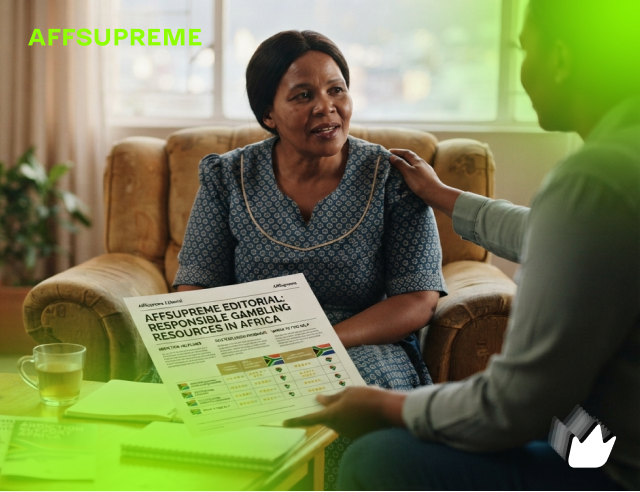
Responsible Gambling Resources in Africa (2026): Helplines, Self-Exclusion and Free Support by Country
Betting is now part of daily life in much of Africa, and so is gambling harm. South Africa’s national helpline reports that calls for help have more than doubled, Uganda’s regulator has seen more than 16,700 players use self-exclusion, and Nigeria launched its first national toll-free gambling helpline only in November 2026. If gambling is costing you or someone close to you more than money you can afford to lose, help exists, much of it free and confidential.
This guide brings together the responsible gambling resources we could verify in South Africa, Nigeria, Ghana, Kenya, Tanzania, Uganda and Zambia: helplines, counselling, self-exclusion schemes, blocking tools and support for families. Every number below was checked against a named source in November 2026; where we couldn’t confirm a number, we say so rather than guess. This page contains no betting links.
This page is for information and support. It contains no affiliate or betting links. If you’re in immediate danger or thinking about harming yourself, contact emergency services or a crisis line straight away (see the crisis section below).
📌 Key takeaways
- South Africa: the National Responsible Gambling Programme runs a free 24/7 helpline on 0800 006 008, plus WhatsApp or SMS “HELP” to 076 675 0710.
- Nigeria: the African Responsible Gaming Network launched a national toll-free gambling helpline, 0800-0043-84357, in November 2026. Lagos players can self-exclude from all licensed operators through LSLGA’s SafePlay.
- Uganda: the NLGRB’s toll-free line, 0800 285 800, connects callers to free counselling and rehabilitation.
- Tanzania: the Gaming Board’s toll-free number is 0800 110 051; operators must self-exclude you on request for at least six months.
- Ghana: the Gaming Commission runs a Responsible Gaming Call Centre (number published at launch: 0540559406) and handles self-exclusion requests.
- Kenya: new 2026 regulations set a minimum six-month self-exclusion that can’t be shortened, with a central register planned.
- Free blocking tools such as BetBlocker can block gambling sites and apps on your phone.
📞 Gambling helplines at a glance
| Country | Helpline | Run by | Notes |
|---|---|---|---|
| 🇿🇦 South Africa | 0800 006 008; WhatsApp/SMS “HELP” to 076 675 0710 | SA Responsible Gambling Foundation (NRGP) | Free, 24/7, counselling and treatment referrals |
| 🇳🇬 Nigeria | 0800-0043-84357 | African Responsible Gaming Network (ARGN) | First national toll-free gambling helpline (Nov 2026) |
| 🇺🇬 Uganda | 0800 285 800 | NLGRB | Free, confidential counselling and rehabilitation |
| 🇹🇿 Tanzania | 0800 110 051 | Gaming Board of Tanzania | Toll-free; the Board’s licence lists don’t state opening hours |
| 🇬🇭 Ghana | 0540559406 | Gaming Commission Responsible Gaming Call Centre | Published hours at launch: 8:00 am to 5:00 pm daily |
| 🇰🇪 Kenya | 1199 (emotional support) | Kenya Red Cross | Toll-free; can refer callers to further services |
| 🇿🇲 Zambia | No national gambling helpline found | — | See GameAid Zambia and Lifeline Zambia below |
Sources: NGB and SARGF (South Africa); FocusGN (Nigeria); NLGRB and Business Focus (Uganda); Footboom, citing the Gaming Board’s licence lists (Tanzania); B&FT (Ghana); Business Today (Kenya); Bolanews and Find A Helpline (Zambia). Numbers can change; if one doesn’t connect, use the alternatives in each country section.
🚩 Signs that gambling is becoming a problem
Gambling problems rarely start suddenly. They usually build up through habits that feel manageable at first. Gauteng’s official tourism site, in its responsible gambling guidance, lists warning signs such as “spending more money or time on gambling than planned, or chasing losses”. Other common signs include:
Chasing losses
Betting more, or more often, to win back what you’ve lost.
Borrowing to gamble
Using loans, mobile credit, family money or savings meant for essentials.
Hiding it
Lying about how much or how often you bet, or deleting betting history.
Feeling unable to stop
More than 40% of callers to South Africa’s NRGP helpline said they felt unable to stop gambling without professional help, NovaNews reported.
Money trouble
32% of NRGP callers in the same study were experiencing financial difficulties.
Mood and relationships
Stress, anxiety, irritability when not betting, and conflict with family over money.
If several of these sound familiar, it’s a good time to talk to someone. You don’t need to be in crisis to call a helpline: South Africa’s NRGP, for example, begins with “a comprehensive triage and screening assessment to evaluate your risk level and determine the correct care path”.
☎️ What happens when you call a helpline
Many people put off calling because they don’t know what to expect. South Africa’s NRGP describes its process in detail, and it gives a good idea of how gambling helplines work:
- You make contact by phone (0800 006 008) or WhatsApp (076 675 0710). You don’t need a referral.
- A trained counsellor talks with you in “a free and confidential conversation”, the SARGF says.
- They assess your gambling and any related concerns, using a triage and screening assessment “to evaluate your risk level and determine the correct care path”.
- They explain your options: information about available treatment and support.
- They can refer you to a qualified mental health professional for ongoing counselling where appropriate, through a nationwide treatment network. Counselling can be individual or couple-based.
- Family members can get support too, whether or not the person gambling has called.
Services elsewhere work differently, but most follow a similar pattern: listen, assess, then point you to counselling, self-exclusion or other help. Uganda’s NLGRB offers counselling and rehabilitation, and Nigeria’s GamblePause offers counselling, self-help resources and treatment referrals. You can hang up at any time, and you don’t have to commit to anything on the first call.
📊 How big is gambling harm in Africa?
Reliable data is limited, but the figures available point the same way:
- South Africa: the National Gambling Board’s 2024/25 annual report recorded a 623% year-on-year increase in calls to the NRGP toll-free helpline, from 140,000 to over one million, Bizcommunity reported. The SARGF also reported a 55% rise in addiction-related calls in the year to February 2025, from 2,600 to over 4,100 (EWN).
- Uganda: more than 16,700 players have used self-exclusion through the National Central Electronic Monitoring System, Sigma and the Daily Monitor reported. Since February 2025, the Gaming Board’s call centre has received 2,398 general calls, including 320 related to responsible gaming.
- Ghana: the Gaming Commission receives “at least three formal self-exclusion requests weekly”, the Acting Commissioner said in May 2025, and a Commission and Mental Health Authority initiative found nearly 70% of young people engage in some form of gambling.
- Nigeria: Gamble Alert’s Advocacy School Tour has reached over 23,000 secondary school students across southwestern Nigeria, The Guardian Nigeria reported, and in 2025 GamblePause opened what it described as Nigeria’s first free gambling rehabilitation centre, in Yaba, Lagos.
- Ghana (students): a study commissioned by the Gaming Commission found that over 27% of university students gamble daily or weekly, Graphic Online reported.
Behind each number is a person who reached out. If you’re thinking about it, you’d be far from alone.
🪜 What to do right now if gambling is hurting you
- Pause. Stop placing bets for today. Log out and close the apps.
- Call a helpline in your country (see the table above). It’s free and confidential.
- Self-exclude from the sites you use, or through a national scheme where one exists (Lagos SafePlay, Uganda’s NCEMS, South Africa’s provincial boards).
- Install a blocker such as BetBlocker on your phone.
- Protect your money: hand control of savings to someone you trust for a while, and remove saved betting payment details.
- Tell someone you trust. Support from family and friends makes recovery easier, as Ghana’s Gaming Commission has stressed.
- Get help with debts if needed, before borrowing more. Ask your helpline about debt advice services where you live.
🇿🇦 South Africa
South Africa has the continent’s most established support system. The South African Responsible Gambling Foundation (SARGF) is a public-private partnership between the National Gambling Board, the provincial licensing authorities and the gambling industry, and its flagship National Responsible Gambling Programme (NRGP) integrates education, research and treatment.
| Service | Contact | What it offers |
|---|---|---|
| NRGP counselling line | 0800 006 008 (toll-free, 24/7) | Counselling, screening, referrals for free treatment, family support |
| NRGP WhatsApp / SMS | “HELP” to 076 675 0710 | Chat with a counsellor |
| NRGP email | helpline@responsiblegambling.org.za | Self-exclusion counselling sessions and enquiries |
| SADAG Suicide Crisis Helpline | 0800 567 567 (24 hours) | Crisis support |
| LifeLine South Africa | 0861 322 322 | Counselling for emotional issues, including gambling-related stress |
| Gamblers Anonymous South Africa | gamblersanonymous.co.za | Free, anonymous peer support meetings |
Self-exclusion. Self-exclusion is a legislated programme in South Africa: anyone can apply, and an excluded person can’t take part in any gambling activity for six months, the SARGF says. The National Gambling Board’s advice is to ask your gambling operator to exclude you (its security department can explain the forms), then contact the NRGP for counselling; the self-exclusion counselling sessions are free. Requests to lift an exclusion are considered only once it has been in force for six months and you’ve attended counselling with one of the NRGP’s treatment professionals.
Students: in February 2026 the National Gambling Board and the National Student Financial Aid Scheme (NSFAS) announced a partnership to protect students from gambling-related harm, after reports of students using NSFAS allowances to bet. It prioritises preventative education, IOL reported.
Note on contact details: Gauteng’s tourism site lists 0861 111 235 for Gamblers Anonymous, while Bizcommunity lists regional numbers for Gauteng, KwaZulu-Natal and the Western Cape; check the GA South Africa website for your area. EWN printed a different NRGP email address (counsellor@responsiblegambling.co.za) from the one on the National Gambling Board’s site; we list the NGB’s version.
🇳🇬 Nigeria
Nigeria’s support network has grown quickly since 2025:
- National helpline: the African Responsible Gaming Network (ARGN) launched its Nigeria chapter and a national toll-free support line, 0800-0043-84357, which ARGN says is “the first national toll-free service of its kind in Nigeria”, FocusGN reported in November 2026. ARGN says it isn’t funded by gambling operators.
- SafePlay (Lagos): on 6 August 2025, the Lagos State Lotteries and Gaming Authority launched SafePlay, a self-exclusion portal where players can “voluntarily exclude themselves from all licensed gambling platforms in the state”, iGaming Business reported. You choose a period from 24 hours to permanent exclusion, FocusGN reported, and the portal also points users to recovery resources.
- GamblePause: offers free, confidential support in Nigeria, including counselling, self-help resources and treatment referrals, and runs a free face-to-face rehabilitation centre in Yaba, Lagos, offering individual counselling, group therapy and family support sessions (FocusGN, ThisDay). It has also added gambling-blocking tools and helps players request exclusion from individual operators.
- Gamble Alert: an independent non-profit that provides free gambling therapy, practical advice and emotional support, The Guardian Nigeria reports. By March 2026, 20 operators had integrated its support infrastructure into their websites, ThisDay said.
- Mentally Aware Nigeria Initiative (MANI): listed by Find A Helpline as offering free, confidential support over the phone.
“We are proud to be the first subnational authority in Nigeria to implement a comprehensive self-exclusion program,” LSLGA’s CEO said at SafePlay’s launch. If you play outside Lagos, use the self-exclusion tools on each operator’s site.
🇬🇭 Ghana
- Responsible Gaming Call Centre: the Gaming Commission opened a call centre, set up with IT equipment donated by betPawa, to offer emotional and psychological support to punters. The number published at its launch was 0540559406, open 8:00 am to 5:00 pm daily (B&FT, Citi Newsroom). These details date from the launch; we couldn’t confirm them on the Commission’s own site, which was unreachable.
- Referrals: the Commission currently refers people struggling with gambling addiction to mental health institutions, the Acting Commissioner said in May 2025, adding that Ghana must invest in specialised rehabilitation centres.
- Self-exclusion: the Commission handles formal self-exclusion requests, receiving at least three a week. Its chairman, James Enu, told Sigma that a shared industry database is a priority, after inspectors found a self-banned player “went into a different casino” that “couldn’t detect that he was on self-ban”.
- Counselling: betPawa partnered with the Baks-Calmare Enclave Foundation, which describes itself as “the most active centre of its kind in Ghana”, to provide advisory and therapy services for gambling addiction, MyJoyOnline reported.
- Biometric checks: Ghana’s 2025 biometric verification rule is intended partly to help operators “implement exclusion frameworks for vulnerable or self-excluded individuals”.
🇰🇪 Kenya
Kenya’s rules changed under the Gambling Control Act 2025, signed on 7 August 2025, which replaced the Betting Control and Licensing Board with the Gambling Regulatory Authority (GRA).
- Self-exclusion: under the Gambling Control (Conduct of Gambling Operations) Regulations 2026, in force since 30 June 2026, you can self-exclude for a minimum of six months, and “the exclusion period cannot be revoked or shortened before it expires”, Business Daily reported. Operators are banned from sending promotions to self-excluded players, must build automated systems that reject their deposits, and risk suspension or revocation of their licence for repeatedly accepting their bets.
- Family-initiated exclusion: the same regulations open the way for third-party-initiated closure of betting accounts; family members can apply to the regulator to exclude a relative whose gambling has caused or is likely to cause harm (Business Daily, TechCabal).
- Addiction unit: the GRA set up a specialised unit in April 2026 to track gambling addiction and enforce consumer protections, The Star reported.
- Support: the Kenya Red Cross helpline 1199 provides immediate emotional support and referrals, Business Today says. The Responsible Gambling Federation of Kenya provides access to support groups, The Star reported, and the Gaming Awareness Society of Kenya (GASK) runs peer-support training and installs gambling-blocking software for at-risk people, Sigma reported.
- Chukua Control: the Association of Gaming Operators of Kenya’s “Chukua Control” (“Take Control”) campaign urged bettors to set limits and take breaks and, according to The Standard, directed them to a national gambling helpline, 1190. We found that number in only one source, so check it before relying on it. AGOK also said its members would provide 24/7 toll-free helplines; check your operator’s site for its number.
- Health cover: the government said in 2025 that it had integrated gambling rehabilitation services into Social Health Authority (SHA) packages, The Star reported.
🇹🇿 Tanzania
- Gaming Board toll-free line: 0800 110 051, which licensed operators show on their sites and adverts. The Board’s lists don’t state its opening hours.
- Self-exclusion with operators: under the Gaming (Internet Gaming) Regulations 2022, a licensee must exclude a player at the player’s request, and for six months the player can’t be reinstated without the Board’s approval. Footboom summarises this rule (GN No. 478T, r.48). For now there’s no central electronic register; the Board’s Director General says one is planned.
- Board-circulated exclusion: you can ask the Board to circulate your details to gambling venues. Its Director General, James Mbalwe, said “the particulars and photos of self-excluded players are taken and circulated to operators”, a manual process he called “not adequate”, iGaming Business reported. The Board plans an electronic central database so operators can identify self-excluded players in real time, but no launch date has been announced (Sigma).
- Limits: players must be able to set deposit or wager limits, and changes take effect after seven days.
- Temporary restrictions: the Board has introduced measures to temporarily restrict compulsive gamblers from betting, FocusGN reported.
🇺🇬 Uganda
- NLGRB toll-free line: 0800 285 800. “The Board offers confidential voluntary counseling and rehabilitation services to people affected by gambling,” the NLGRB says. Its CEO said support “is confidential and free”.
- Self-exclusion: more than 16,700 players have self-excluded through the National Central Electronic Monitoring System. The 2025 Responsible Gaming Directives introduced “self-exclusion & restricted-person registers” and require operators to refuse service to excluded persons.
- Exclusion periods: players have suspended access for periods from one week to one month, with some choosing longer, FocusGN reported.
- Self-check: the NLGRB’s website has a self-evaluation quiz to help you judge whether gambling is becoming a problem.
- Education: the Board’s education programmes have reached more than 33,500 students and 1,600 teachers, with messaging focused on treating gaming as entertainment rather than a source of income (Sigma).
- Age: only people aged 25 and above may gamble in Uganda.
- Warnings: online operators must display the slogan “Betting is addictive and can be psychologically harmful” and show elapsed playtime.
🇿🇲 Zambia
We couldn’t find a national gambling helpline number for Zambia. Available support includes:
- GameAid Zambia: an organisation focused solely on gambling addiction. With funding from BolaBet, it offers online, phone and in-person counselling and runs family support groups and peer support programmes, Bolanews and Diggers reported.
- GamblePause: the Nigeria-based organisation has registered in Zambia and plans to work with GameAid; it hasn’t announced a timeline (FocusGN, Sigma).
- Lifeline Zambia: Find A Helpline lists LifeLine/ChildLine Zambia, a non-governmental organisation providing counselling, guidance and referral services, as its gambling helpline for Zambia. Check its current contact details there.
- Regulator complaints: the Betting Control and Licensing Board (BCLB) oversees betting and handles complaints about licensed operators.
- Age: betting is prohibited under 18 under the Betting Control Act, as amended in 2021.
⛔ Self-exclusion across Africa, compared
Self-exclusion means asking to be barred from gambling for a set period. It’s one of the most effective tools available, but it works very differently from country to country:
| Country | How to self-exclude | Minimum period | Covers all operators? |
|---|---|---|---|
| 🇿🇦 South Africa | Ask your operator, then contact the NRGP | 6 months; lifted only with proof of counselling | Legislated programme |
| 🇳🇬 Nigeria (Lagos) | LSLGA’s SafePlay portal | From 24 hours to permanent, chosen by the player | Yes, all LSLGA-licensed platforms |
| 🇬🇭 Ghana | Request to the Gaming Commission or operator | Not stated in our sources | A shared database is planned |
| 🇰🇪 Kenya | With operators under the 2026 regulations; families can also apply | 6 months; can’t be shortened | Operators must keep exclusion registers |
| 🇹🇿 Tanzania | With each operator; or ask the Board to circulate details | 6 months before reinstatement without Board approval | Not yet; central database planned |
| 🇺🇬 Uganda | Through operators linked to NCEMS | From one week | Via NCEMS and the restricted-person registers |
Tips for self-exclusion: exclude from every site you use, not just your favourite; ask for written confirmation; withdraw or ask about any remaining balance before the exclusion starts; and combine exclusion with a blocker so new sites don’t tempt you.
🧭 How to self-exclude, country by country
🇿🇦 South Africa
Contact your operator’s security or customer team and ask for the self-exclusion forms, then call the NRGP on 0800 006 008 or email helpline@responsiblegambling.org.za to book your free counselling sessions.
🇳🇬 Lagos, Nigeria
Use LSLGA’s SafePlay portal and choose your period, from 24 hours to permanent. It covers all LSLGA-licensed platforms. Outside Lagos, request exclusion from each operator; GamblePause advisers can help.
🇰🇪 Kenya
Apply to your operator for at least six months. Once it starts, it can’t be shortened. If a relative’s gambling is causing harm, family members can apply to the regulator.
🇹🇿 Tanzania
Ask each licensed operator to exclude you (the rule is in the Gaming (Internet Gaming) Regulations 2022), and ask the Gaming Board, on 0800 110 051, about having your details circulated to venues.
🇺🇬 Uganda
Use the self-exclusion option on your operator’s platform; operators must enforce it and refuse service to excluded people. Call the NLGRB on 0800 285 800 for counselling.
🇬🇭 Ghana
Ask the operator to exclude you and contact the Gaming Commission, which handles formal self-exclusion requests. Until the shared database launches, exclude from each operator and casino separately.
🛡️ Blocking tools for your phone and computer
Blocking software stops your devices opening gambling sites and apps. GamCare says “many people tell us blocking software is a useful tool if they find it hard to control their gambling”.
| Tool | Cost | Devices | Notes |
|---|---|---|---|
| BetBlocker | Free | Windows, Linux, Mac, iOS, Android and Fire OS (GamCare) | Run by a UK and US registered charity; anonymous to use; includes a scheduling tool (iGaming Business). Choose a block from a short break to permanent exclusion (App Store) |
| Gamban | Paid | Mac, Windows, Android and iOS (GamCare) | Blocks gambling sites and apps; Nigeria’s Gamble Alert has promoted it locally (Tribune) |
| GamBlock / Net Nanny | Paid | GamBlock: Windows and Android; Net Nanny: Windows, iOS, Android (GamCare) | Net Nanny is a general blocker that can also be used as parental controls |
| Phone’s built-in limits | Free | Android Digital Wellbeing; iPhone Screen Time | Set an app timer to zero or restrict app installs |
Blocking tools aren’t perfect. Some users report that blockers miss certain sites, and an app with device-admin rights can be hard to remove. Download blockers only from official app stores or the developer’s own site, never from a gambling site’s link.
🎛️ Tools inside betting apps
Licensed operators across Africa are increasingly required to provide player-protection tools:
- Deposit and loss limits: required in Tanzania, where changes take effect after seven days, and in Uganda’s 2025 directives.
- Time-outs and cooling-off periods: short breaks; Kenya’s new framework requires operators to offer cooling-off periods (The Star).
- Self-exclusion: longer bans, which operators must enforce and during which they must stop marketing to you (Kenya, Uganda).
- Reality checks: Uganda requires online operators to show elapsed playtime.
- Marketing opt-outs: turn off promotional SMS, email and push notifications in your account settings.
Use these tools early, before problems grow. Setting a deposit limit on the day you open an account is easier than trying to set one after a bad week.
💳 Protecting your money
- Remove saved cards and mobile money details from betting accounts.
- Ask a trusted person to hold savings or co-manage your accounts for a while.
- Avoid instant loans and mobile credit for betting.
- Get debt advice early; your helpline can point you to services.
- Never bet with money meant for essentials such as rent, food, school fees or student allowances.
👪 Help for families and friends
Gambling harm affects partners, children and parents too. South Africa’s NRGP offers “support for family members and loved ones affected by gambling-related harm”, GameAid Zambia runs family support groups, and in Kenya families can now apply to have a relative excluded.
- Choose a calm moment to talk, and focus on specific behaviour rather than labels.
- Protect household money: separate accounts, and don’t pay off gambling debts without a plan.
- Encourage professional help and offer to be there when they call a helpline.
- Look after yourself: you can call helplines for your own support, even if the person gambling won’t.
- Watch for crisis signs: if someone talks about harming themselves, contact a crisis line or emergency services immediately.
🧒 Protecting young people
Underage betting is a growing concern across the continent. Ghana’s Commission and Mental Health Authority found nearly 70% of young people engage in some form of gambling, Nigeria’s Gamble Alert runs school tours, and South Africa’s NRGP runs the “Taking Risks Wisely” programme to inform school-aged learners about the dangers of illegal underage gambling. Parents can:
- Use parental controls and blocking tools on children’s phones.
- Keep ID documents and mobile money PINs secure.
- Talk openly about how betting adverts work and why “sure wins” don’t exist.
- Report operators that let minors bet to the regulator.
🌍 Pan-African initiatives
2026 brought the first continent-wide responsible gambling efforts:
- Africa Safer Gambling Week (7–11 September 2026): organised by the African iGaming Alliance with regulators and industry bodies under the #PlaySafeAfrica banner. Regulators including South Africa’s NGB, Lagos’s LSLGA, Uganda’s NLGRB and the Gaming Board of Tanzania took part. The Alliance plans to make it annual.
- African Responsible Gaming Network (ARGN): launched on 21 September 2026, with founding partners including GamblePause Initiative Africa, Gamble Aware Nigeria and the South African Responsible Gambling Foundation. SARGF’s Lebo Seoheng was appointed president. Its 11 member countries include South Africa, Nigeria, Zambia, Zimbabwe, Kenya, Malawi, Botswana, Namibia, Cameroon, Uganda and Eswatini.
- Safer Gaming Month (November 2026): ARGN’s campaign across its 11 countries under the theme “It Starts with YOU”. Nigeria’s national helpline launched as part of it. ARGN’s priorities include an African gambling harm insight brief and a directory of treatment and recovery services (FocusGN).
ARGN aims to promote “common principles rather than identical regulations” across member countries, FocusGN reported.
🏛️ What regulators require of operators
| Country | Key player-protection rules |
|---|---|
| 🇺🇬 Uganda | 2025 Responsible Gaming Directives: self-exclusion and restricted-person registers, deposit and time limits, marketing restrictions, the warning “Betting is addictive and can be psychologically harmful”, elapsed playtime |
| 🇰🇪 Kenya | Gambling Control Act 2025 and 2026 regulations: minimum six-month irrevocable self-exclusion, no marketing to excluded players, automated deposit rejection, licence penalties for breaches, and no gambling adverts on TV or radio between 6am and 10pm except during live sport (The Star) |
| 🇹🇿 Tanzania | Internet Gaming Regulations 2022: self-exclusion on request (six months before reinstatement without Board approval), deposit/wager limits, Board toll-free number on adverts |
| 🇬🇭 Ghana | Biometric Ghana Card verification to enforce limits and exclusions |
| 🇳🇬 Nigeria (Lagos) | SafePlay multi-operator self-exclusion for all LSLGA licensees |
| 🇿🇦 South Africa | Legislated self-exclusion; the SARGF is funded by an industry contribution pegged at 0.1% of gross gambling revenue (NGB) |
If an operator ignores your self-exclusion, keeps sending you promotions after you’ve excluded, or lets a minor bet, report it to the regulator in your country.
🆘 If you’re in crisis
Gambling problems can lead to overwhelming stress, debt and despair. If you’re thinking about harming yourself, please reach out now:
- South Africa: SADAG Suicide Crisis Helpline, 0800 567 567 (24 hours); LifeLine, 0861 322 322.
- Kenya: Kenya Red Cross, 1199 (toll-free).
- Everywhere: go to the nearest hospital or emergency service, or call a trusted person to be with you.
The gambling helplines in this guide can also help you find crisis and mental health support in your country. Find A Helpline lists free, confidential services by country and topic.
🌱 What recovery looks like
Recovery from problem gambling is possible, and it usually combines several kinds of support rather than willpower alone:
Counselling
Free counselling is available through South Africa’s NRGP, Uganda’s NLGRB and Nigeria’s Gamble Alert, among others.
Peer support
Gamblers Anonymous in South Africa, peer programmes from GameAid Zambia and GASK in Kenya.
Barriers
Self-exclusion and blocking tools make it harder to act on urges.
Money management
Handing over control of finances and getting debt advice.
Mental health care
Ghana’s Commission works with the Mental Health Authority, and many people also need support for anxiety or depression.
Time
Setbacks happen. A slip isn’t failure; call your helpline again.
❓ Myths about gambling problems
“Only people who lose everything need help”
No. Helplines screen callers at every risk level, and early help is easier.
“I can win it back”
Chasing losses is one of the clearest warning signs. The odds don’t change because you’ve lost.
“Helplines cost money”
The national lines in this guide are toll-free, and counselling through the NRGP and NLGRB is free.
“Self-exclusion is permanent”
Most schemes run for set periods: from one week in Uganda and 24 hours on Lagos’s SafePlay, to a minimum of six months in Kenya, Tanzania and South Africa.
“Calling will get me in trouble”
Services describe themselves as confidential; they’re there to help, not to judge.
“Betting is a way to earn income”
Uganda’s regulator focuses its education on treating gaming as entertainment rather than a source of income, and Ghana’s Acting Commissioner said gaming should entertain, not create hardship.
📝 A simple personal safety plan
- Write down your helpline number and save it in your phone.
- List your triggers: paydays, big matches, boredom, stress, notifications.
- Set limits or self-exclude on every account.
- Install a blocker on every device.
- Choose a support person and tell them about your plan.
- Plan replacement activities for the times you’d usually bet.
- Review your plan weekly for the first few months.
🚫 Common mistakes when trying to cut down
- Self-excluding from one site and moving to another.
- Keeping betting apps installed “just to check scores”.
- Using unlicensed offshore sites, which won’t honour local self-exclusion.
- Borrowing to cover losses before talking to anyone.
- Going it alone instead of using free counselling.
- Ignoring the impact on family, who may need support too.
✅ Responsible gambling checklist
- I only bet money I can afford to lose.
- I’ve set deposit limits on every account.
- I know my country’s helpline number.
- I never borrow to gamble.
- I take regular breaks and use time-outs.
- I don’t chase losses.
- I use only licensed operators.
- I’m of legal age: 18+ in most countries, 25+ in Uganda.
📖 Glossary
- Self-exclusion: asking to be barred from gambling for a set period.
- Time-out: a short break from an operator, usually days or weeks.
- Deposit limit: a cap on how much you can deposit over a period.
- Blocking software: apps that stop devices opening gambling sites and apps.
- NRGP: South Africa’s National Responsible Gambling Programme.
- SARGF: South African Responsible Gambling Foundation.
- SafePlay: Lagos’s multi-operator self-exclusion portal.
- NCEMS: Uganda’s National Central Electronic Monitoring System.
- ARGN: African Responsible Gaming Network.
- Chasing losses: betting more to win back money already lost.
🔍 How we researched this guide
Every helpline number in this guide was checked against a named source in November 2026. South African details come from the National Gambling Board, the SARGF, IOL, Bizcommunity, EWN, NovaNews, SADAG and Gauteng Tourism. Nigerian details come from FocusGN, CDC Gaming, iGaming Business, ThisDay, The Guardian Nigeria, Sigma and Find A Helpline. Ghanaian details come from B&FT, Citi Newsroom, MyJoyOnline, Gambling Insider, Sigma, News Ghana, GhanaWeb and Graphic Online. Kenyan details come from Business Daily, TechCabal, The Star, The Standard, KBC, Business Today, Capital FM, Bowmans and Sigma. Tanzanian details come from Footboom, iGaming Business, Sigma, FocusGN and the Gaming (Internet Gaming) Regulations 2022. Ugandan details come from the NLGRB, Business Focus, Daily Monitor, Sigma and FocusGN. Zambian details come from Diggers, Bolanews, Sigma, FocusGN and Find A Helpline. Pan-African details come from Sigma, FocusGN, iGaming Business, ThisDay, AllAfrica and SCCG. Blocking tool details come from GamCare, iGaming Business, the App Store and Tribune Nigeria. Where we couldn’t confirm a number, we say so.
❓ Frequently asked questions
What is South Africa’s gambling helpline?
The National Responsible Gambling Programme: 0800 006 008, free and 24/7, or WhatsApp/SMS “HELP” to 076 675 0710.
Is the South African helpline free?
Yes. The toll-free helpline operates 24/7, 365 days a year, and counselling is free, Bizcommunity reports; self-exclusion counselling sessions are also free.
What is Nigeria’s gambling helpline?
The ARGN national toll-free line, 0800-0043-84357, launched in November 2026.
What is SafePlay?
The Lagos State Lotteries and Gaming Authority’s self-exclusion portal, launched on 6 August 2025, which bars you from all LSLGA-licensed platforms for a period you choose, from 24 hours to permanent.
Does Gamble Alert offer free help?
Yes. The Nigerian non-profit provides free gambling therapy, practical advice and emotional support.
What is Uganda’s gambling helpline?
The NLGRB’s toll-free line, 0800 285 800, which connects callers to free, confidential counselling and rehabilitation.
How many people have self-excluded in Uganda?
More than 16,700 through the National Central Electronic Monitoring System, Sigma reported; FocusGN cited 16,811 in FY2025/26.
What is Tanzania’s gambling helpline?
The Gaming Board of Tanzania’s toll-free number, 0800 110 051.
How does self-exclusion work in Tanzania?
A licensed operator must exclude you on request, and you can’t be reinstated for six months without the Board’s approval. You can also ask the Board to circulate your details to venues.
Where can I get help in Ghana?
The Gaming Commission’s Responsible Gaming Call Centre (number published at launch: 0540559406, 8:00 am to 5:00 pm daily) and its self-exclusion process; the Baks-Calmare Enclave Foundation offers counselling.
Can I self-exclude in Ghana?
Yes. The Gaming Commission receives at least three formal self-exclusion requests a week and plans a shared industry database.
Where can I get help in Kenya?
The Kenya Red Cross helpline 1199 for emotional support and referrals, community groups via the Responsible Gambling Federation of Kenya, and operators’ own helplines.
How long is self-exclusion in Kenya?
At least six months under the 2026 regulations, and it can’t be revoked or shortened before it expires. Family members can also apply to have a relative excluded.
Is there a gambling helpline in Zambia?
We couldn’t find a national gambling helpline. GameAid Zambia offers online, phone and in-person counselling, and Find A Helpline lists Lifeline Zambia.
Can I lift a self-exclusion early in South Africa?
Only after it has been in force for six months and you’ve attended counselling with an NRGP treatment professional.
What is the best free gambling blocker?
BetBlocker is free and works on Windows, Mac, Linux, iOS, Android and Fire OS. Gamban is a paid alternative.
Do blocking apps work on all sites?
Not always. Use a blocker alongside self-exclusion, and download it only from an official store.
What are the signs of a gambling problem?
Spending more time or money than planned, chasing losses, borrowing to gamble, hiding betting, and feeling unable to stop.
Can family members get help?
Yes. South Africa’s NRGP offers free family support, and most helplines will talk to worried relatives.
Is calling a gambling helpline confidential?
The services in this guide describe themselves as confidential.
What is the African Responsible Gaming Network?
A pan-African network launched in September 2026 to coordinate responsible gambling work across 11 countries.
What is Africa Safer Gambling Week?
An annual campaign by the African iGaming Alliance; the first ran from 7 to 11 September 2026.
Will unlicensed sites honour my self-exclusion?
Usually not. Local self-exclusion schemes cover licensed operators, which is another reason to avoid offshore sites.
What if an operator ignores my self-exclusion?
Report it to your country’s regulator. Kenya and Uganda require operators to enforce exclusions and stop marketing to excluded players.
What should I do if I’m in debt from gambling?
Stop betting, talk to a helpline, and ask about debt advice before borrowing more. Avoid loans or mobile credit to cover losses.
Is there help for young people?
Yes. South Africa’s NRGP runs a schools programme, and helplines support people of any age. Gambling is illegal under 18 (under 25 in Uganda).
Are there Gamblers Anonymous meetings in Africa?
Yes, in South Africa; see gamblersanonymous.co.za for meetings and current contact numbers.
What if I’m thinking about harming myself?
Contact a crisis line now: in South Africa, SADAG on 0800 567 567; in Kenya, the Red Cross on 1199; or go to the nearest emergency service.
Can my family stop me from betting in Kenya?
Under the 2026 regulations, family members can apply to the regulator to exclude a relative whose gambling has caused or is likely to cause harm.
Is there free gambling rehab in Nigeria?
Yes. GamblePause runs what it describes as Nigeria’s first free gambling rehabilitation centre, in Yaba, Lagos, with individual counselling, group therapy and family support.
Will Tanzania get a national self-exclusion register?
The Gaming Board plans an electronic central database so operators can identify self-excluded players in real time, but no launch date has been announced.
What happens when I call the NRGP?
A trained counsellor screens your risk level, explains your options and can refer you to a mental health professional for free ongoing counselling.
Can I self-exclude for just a day?
On Lagos’s SafePlay, yes: periods start at 24 hours. Kenya, Tanzania and South Africa have six-month minimums for formal self-exclusion.
Can I set limits instead of self-excluding?
Yes. Licensed operators offer deposit limits and time-outs; in Tanzania, limit changes take effect after seven days.
Do I have to stop gambling completely?
That’s a decision to make with a counsellor. For many people with a gambling problem, stopping completely is the safest path.
How do I help a friend who gambles too much?
Talk calmly about specific behaviour, encourage them to call a helpline, offer to be with them, and protect shared money.
Where can I find helplines for other countries?
Find A Helpline lists free, confidential services by country and topic.
🧘 You’re not alone
Reaching out is a sign of strength, not weakness. Thousands of people across Africa have already called a helpline, set up self-exclusion or joined a support group. If gambling is affecting your life, your money or your family, make one call today.
- South Africa: 0800 006 008 (24/7) · WhatsApp/SMS “HELP” to 076 675 0710.
- Nigeria: 0800-0043-84357 (ARGN) · Lagos SafePlay self-exclusion.
- Uganda: 0800 285 800 (NLGRB).
- Tanzania: 0800 110 051 (Gaming Board).
- Ghana: Gaming Commission call centre, 0540559406 (number published at launch).
- Kenya: Kenya Red Cross, 1199.
🏁 Final word: getting help in Africa
Responsible gambling support in Africa has improved sharply. South Africa has a 24/7 national helpline and a legal self-exclusion scheme; Nigeria now has its first national toll-free line and Lagos’s SafePlay; Uganda offers free counselling and a technology-backed exclusion system used by more than 16,700 people; Tanzania and Kenya have six-month self-exclusion rules; and Ghana is building a shared exclusion database. Gaps remain, especially in Zambia, where we found no national helpline. Whatever country you’re in, the steps are the same: pause, call, exclude, block and tell someone. Help is free, confidential and closer than you think.
SA 0800 006 008 · Nigeria 0800-0043-84357 · Uganda 0800 285 800 · Tanzania 0800 110 051 · Kenya 1199